A blog collecting data that are not (yet) included in our books on Pluto & Charon, Titan, Ceres and other lesser worlds of the outer solar system.
What is this about
This blog collects supplemental data on lesser worlds of the solar system (like Pluto and Titan) that have not (yet) been included in our books. You may contribute to our blog with brief articles that we will on your request also translate for our monolingual audience. The only precondition: Your content must in some way relate to dwarf planets or large moons of the solar system.
Send your text to: i n f o (youknowwhichsign) c o d e x - r e g i u s . e u
Dienstag, 22. Oktober 2019
Pluto's Far Side revealed
For the first time, the other side of Pluto that New Horizons has not flown over is discussed here in detail:
https://arxiv.org/ftp/arxiv/papers/1910/1910.08833.pdf
Freitag, 23. August 2019
Meine Artikel für Perry Rhodan
In einem alten Manuskriptordner entdeckte ich die Korrekturfahnen von mehreren Artikeln, die ich im Zeitraum zwischen den Perry-Rhodan-Heften 1000 und 2000 im Perry-Rhodan-Report und dem Perry-Rhodan-Journal veröffentlichte. Da diese Artikel seit Langem vergriffen, aber von einem gewissen historischen Interesse sind, habe ich sie OCR-gescannt und stelle sie hier kostenlos online. Zwei weitere Artikel wurden inzwischen nachgedruckt, entsprechende Links verweisen auf die Quellen.
- Am Ende eines schönen Traums - Verbesserung der Antithese (Perry-Rhodan-Report 92 in Perry Rhodan 1116)
Um was ging es eigentlich in diesem Beitrag?
- Lebensforschung von der Dritten Macht bis zum Galaktikum - Probleme der Biologie im Kosmischen Zeitalter (Perry-Rhodan-Report 144 in Perry Rhodan 1328)
Überlegungen zur Erweiterung der biologischen Klassifikation auf außerirdische Lebensformen
- Die Geschichte der Superintelligenz ES und ihrer Mächtigkeitsballung - Fakten über die Lokale Galaxiengruppe (Perry-Rhodan-Report 162 in Perry Rhodan 1400)
Dieser Beitrag enthielt erstmals die These, die MdI seien Marionetten von Anti-ES gewesen. Japanische Übersetzung abgedruckt in „Element 10“, Magazin des Fanclubs „Millenium Sol '89“, mit Genehmigung des Autors
- Das Universum im Spiegel Perry Rhodans - Überblick über die Galaxien bis Band 1440 (Perry-Rhodan-Report 177 und 178 in Perry Rhodan 1460/1464)
Zweiteilige astronomische Kurzbeschreibung (fast) aller Galaxien, die in den Heften 1 bis 1440 Handlungsorte der Perry-Rhodan-Serie waren.
- Die Galaxis K'aan und der Ursprung der humanoiden Rassen (in Zusammenarbeit mit Dr. G. Radons, Universität Heidelberg; Perry-Rhodan-Report 184 in Perry Rhodan 1488)
Sekundärliterarische Betrachtung zur Serienhandlung mit astronomischen Daten
- Die Rätsel des Unsterblichen (Perry-Rhodan-Report 186 und 187 in Perry Rhodan 1496/1500) Zweiteilige Betrachtung zum Konzept der Unsterblichkeit in der Perry-Rhodan-Serie
- Der Kurs des Schwarms und seine kosmopolitischen Folgen von 147 NGZ bis ins 12. Jahrhundert NGZ (Perry-Rhodan-Report 194 in Perry Rhodan 1528)
Sekundärliterarische Betrachtung zur Serienhandlung. Nachdruck in der SOL 76.
- ES und ANTI-ES: Ein Zwiespalt im Kosmos – Überlegungen (Perry-Rhodan-Report 197 in Perry Rhodan 1540)
Weitere Argumente für eine Aufteilung der Lokalen Gruppe zwischen ES und Anti-ES
- Leerräume der Schöpfung - die großräumige Struktur des Universums (Perry-Rhodan-Report 213 in Perry Rhodan 1604)
Astronomische Einführung über Galaxienhaufen und intergalaktische Leerräume
- Merkmale galaktischer Verkehrssprachen (Perry-Rhodan-Report 241 in Perry Rhodan 1716)
Überlegungen zur Schaffung künstlicher Kommunikationssprachen
- ES - Verhaltensforschung an einer Superintelligenz
Dieser Beitrag ist obskur! Er entstand im Zeitraum der PRRs 250-262, der jüngste zitierte Heftband ist 1749, dagegen ist von der Handlung ab 1800 noch keine Rede. Ich kann aber nicht feststellen, wo er abgedruckt worden ist. Das ist besonders merkwürdig, weil er erstmals die später von Rainer Kastor kanonisierte These enthielt, die doppelte Geschichte von der Entstehung der MdI sei das Produkt des durch die Psiqs verfälschten Zeitablaufs gewesen!
- Die Vergessenen Astronauten (Perry-Rhodan-Journal 141 in Perry Rhodan 1970)
Essay zu einem wenig bekannten Kapitel US-amerikanischer Raumfahrtgeschichte. Inzwischen zu einem Buch erweitert. - Struktur und Aufbau des Kontinents Pthor (Atlan 490-493)
Beschreibung der geographischen, kulturellen und mythologischen Aspekte des Dimensionsfahrstuhls aus dem König-von-Atlantis-Zyklus. Nachdruck in der SOL 70.
Zum Abschluss eine Frage an die Leser: Wer hat noch weitere meiner Artikel greifbar und könnte sie mir als OCR-fähige Scans zur Verfügung stellen?
Sonntag, 24. Februar 2019
Free download of the ebook version
The world was moved to pity when the little Philae spacecraft jumped on Rosetta’s comet into its undoing.
But the European parent probe, Rosetta, continued to orbit the ‘rubber duck‘ comet with the ineffable name and made amazing discoveries. Is 67P/Churyumov-Gerasimenko really a messenger from that part of the solar system in which the dwarf planets are orbiting: a baby pluto, so to speak?
The Rosetta mission has long since been concluded. Its findings are summarized in this book that also presents impressive images of comet 67P.
https://www.amazon.de/dp/B07P37HZN
Donnerstag, 21. Februar 2019
"Rosettas Komet" - ein halbes Jahr verspätet, aber nun doch erschienen
Wir hatten vor gehabt, dieses Buch bereits im Sommer 2018 zu veröffentlichen, aber so ist es eben: Das Schreiben ist nicht unser Hauptberuf und meine Frau und ich waren in der zweiten Hälfte des letzten Jahres so mit Arbeitsaufträgen überschwemmt, dass wir wenig Zeit fanden, etwas anderes zu tun. Außerdem zog eines unserer Kinder aus, um mit dem Studium zu beginnen, und es gab auch andere wichtige Veränderungen in unserem Privatleben..... Wie auch immer, seit Dezember ist sie erhältlich: die fünfte Folge unserer Serie über die Kleinen Welten des Sonnensystems, diesmal nicht über einen Zwergplaneten oder einen großen Mond, sondern über einen Kometen - das Ding mit dem unaussprechlichen ukrainischen Namen, das von der europäischen Raumsonde Rosetta und ihrem kleinen Lander Philae besucht worden ist.
Die Struktur des Buches folgt dem inzwischen vertrauten Muster und erzählt zunächst von der Annäherungsphase, gefolgt von der fast gescheiterten Mission der Philae. Als nächstes beschreiben wir die Topographie, unterteilt in "Körper", "Hals" und "Kopf" des Badeentenkometen, zwei weitere Kapitel behandeln die Chemie zuerst des Kerns, dann der Koma (bzw. der Atmosphäre), und schließlich werfen wir einen Blick auf das Ende des Unternehmens Rosetta und mögliche Folgemissionen.
Eine Leseprobe ist wie gewohnt bei Academia.edu erhältlich.
Der Bestelllink für die Druckausgabe oder das E-Book ist hier: Rosettas Komet.
Was kommt als nächstes? Es gibt noch ein paar Körper im Sonnensystem, die sich für eine gründliche Beschreibung anbieten ...
Die Struktur des Buches folgt dem inzwischen vertrauten Muster und erzählt zunächst von der Annäherungsphase, gefolgt von der fast gescheiterten Mission der Philae. Als nächstes beschreiben wir die Topographie, unterteilt in "Körper", "Hals" und "Kopf" des Badeentenkometen, zwei weitere Kapitel behandeln die Chemie zuerst des Kerns, dann der Koma (bzw. der Atmosphäre), und schließlich werfen wir einen Blick auf das Ende des Unternehmens Rosetta und mögliche Folgemissionen.
Eine Leseprobe ist wie gewohnt bei Academia.edu erhältlich.
Der Bestelllink für die Druckausgabe oder das E-Book ist hier: Rosettas Komet.
Was kommt als nächstes? Es gibt noch ein paar Körper im Sonnensystem, die sich für eine gründliche Beschreibung anbieten ...
"Rosetta's Comet" - half a year too late but here it is
We had planned to publish this book already in summer 2018, but you know - writing is not our main profession and my wife and I where so overwhelmed with work in the second half of last year that we found little time to do anything else. Moreover, one of our children moved out to commence studying and there were other important changes to our private life as well ... Anyway, here it is now: the fifth instalment of our series on Lesser Worlds of the Solar System, this time not discussing a dwarf planet or a major moon but a comet - that thing with the ineffable Ukrainian name that had been visited by the European spacecraft Rosetta and its little lander Philae.
The structure of the book follows the by now familiar pattern, telling first of the approach phase, followed by the almost failed Philae mission. Next, we describe the topography, subdivided into "Body", "Neck" and "Head" of the rubber-ducky comet, two subsequent chapters discuss the chemistry first of the nucleus, then of the coma (or atmosphere), and finally we cast a glance on the end of the Rosetta mission and possible follow-ups.
A sample read is available as usual from Academia.edu.
The order link, for print or e-book, is here: Rosetta's comet. From Sunday, 24 February, to Tuesday, 26 February, the e-book edition will be available for free downloading!
Freitag, 20. April 2018
Vorträge im Mai 2018
6 MAI
|
Ceres - der erdnächste Zwergplanet
|
Gegenüber den 2015 enthüllten Wundern des Plutos wirkte der im gleichen Jahr erstmals von einer Raumsonde abgelichtete Zwergplanet Ceres zwischen Mars und Jupiter auf den ersten Blick wie dessen unscheinbare kleine Schwester. Doch weit gefehlt: Was dem Auge zunächst als öde Mondlandschaft erschien, erwies sich als eine Welt mit überraschenden und unvorhergesehenen Naturwundern.
In diesem Bildervortrag wird der erdnächste Zwergplanet von mir vorgestellt. Der Begleitbildband "Ceres - Plutos kleine Schwester" mit vielen weiteren Abbildungen und Einzelheiten ist über den Online-Buchhandel erhältlich.
Sonntag, 6. Mai 15:00 - 16:00
|
|
Reichklarastr. 1,
55116 Mainz
|
7 MAI
|
Saturnmond Enceladus - Island des Weltraums
|
Der lange Flug der Raumsonde 'Cassini' ging im vergangenen Jahr zu Ende. Eines ihrer vielen Flugziele war der kleine Saturnmond Enceladus, der von weitem wie ein durchgefrorener Schneeball aussieht, sich aus der Nähe als "Island des Weltraums" entpuppt, als eine Welt voller sprudelnder Geysire, in denen es sogar Leben geben könnte.
Die faszinierenden Beobachtungen der "Cassini" werden in diesem Bildervortrag vorgestellt. Ein vertiefender Begleitbildband "Enceladus - Island des Weltraums" ist im Online-Buchhandel erhältlich.
Montag, 7. Mai 20:00 - 21:00
|
Astronomische
Gesellschaft Urania e. V.
Bierstadter Str. 47, 65189 Wiesbaden
|
Freitag, 19. Januar 2018
NEW: Enceladus - Iceland of Space
Among the moons of the ringed planet, Saturn, little Enceladus was the primary target of the Cassini space probe other than huge Titan. And for good reason: Apart from Jupiter’s moon Europa, Enceladus is these days considered the most promising target in the quest for extraterrestrial life in the solar system. In this respect, the moons and dwarf planets of the outer solar system have left long-favoured planet Mars behind by now.Only the last ten years have made evident to us that cold worlds need not be frozen to the core and inanimate. Traces of past or even present activities like earthquakes, geysers, eruptions, snowfalls or even tidal surges can be found on locations from the innermost dwarf planet Ceres to its big brother Pluto far away behind the orbits of the large Jovian giants.
NASA has made it a habit to claim ‘oceans’ in the netherworlds of icy bodies in and beyond the planetoid belt wherever it looks. It may sound encouraging at press conferences because it makes many an audience think of fish, jellyfish and coral. On Enceladus, alleged ‘geysers’ even spray water vapour into the sky, evoking mental images of the Yellowstone National Park, of Iceland or just of Andernach in Germany. Textbook articles, on the other hand, often refer more reservedly to those briny waters inside lesser worlds of the solar system as ‘liquid mantles’.
Both approaches are justifiable, depending on whether you prefer to think in terms associated with water, like a biologist does, or rather like a physicist or volcanologist who prefers to emphasise the analogy of dynamic processes developing on Earth and elsewhere.
We use the latter approach in this book. That way, dynamic phenomena on Enceladus can be described more succinctly, elaborating on the similarities with planets like Earth. For like our homeworld, this minor body is divided into a solid shell, a liquid mantle and, again, a solid core. The geysers, as we will see, closest resemble fissure vents of Iceland hurling molten lava up in long curtains of fire. It seems justified to call Enceladus the Iceland of Space: an Iceland of ice, water and vapour.
Ice plays the role of basalt there, water assumes the role of magma. Volcanologists like to use terms such as cryovolcanism, cryomagma and cryolava to emphasise the differences in chemistry, while the physics stay the same.
Given all the media attention Enceladus has received as the Cassini-Huygens spacecraft crisscrossed Saturn’s system from 2005 to 2017, we find it surprising that no book publisher has so far taken on this fascinatingly exotic world that looks like the backdrop of an imaginative sci-fi film.
In view of the continuing success of our previous books on lesser worlds of the solar system: ‘Pluto & Charon’, ‘Titan - Pluto’s big brother’ and ‘Ceres - Pluto’s little sister’, we have therefore decided to close this gap in the German- and English-speaking markets. Readers who would like to penetrate deeper into the subject are encouraged to read forthcoming ‘Enceladus and the Icy Moons of Saturn’ (ISBN: 0816537070) scheduled to be published in the USA in June 2018 and aiming at the professional audience. Regarding our own series we would like to draw special attention to the ‘Titan’ volume, because it deals with elements of the Cassini-Huygens mission alluded to but not specified in this book.
Print or eBook: Enceladus - Iceland of Space
Sample chapters: Enceladus - Iceland of Space
Freitag, 15. Dezember 2017
NEU: Enceladus - Island des Weltraums
Wer noch ein Weihnachtsgeschenk für einen Hobbyastronomen sucht: Das 4. Buch aus unserer Serie ist heute online gegangen. Am kommenden Montag und Dienstag könnt ihr die Kindle-Version sogar gratis herunterladen. Die großformatige 4-Farb-Druckausgabe wird voraussichtlich im Lauf des Wochenendes bestellbar.
Klappentext:
"Den Voyager-Sonden erschien Enceladus wie ein frischer glatter Schneeball.
Erst die Cassini bemerkte, wie außergewöhnlich dieser kleine Saturnmond ist, dessen Klüfte Geysire in den Himmel spucken, als sei er das Island des Weltraums.
Inzwischen ist die Cassini in den Saturn gestürzt worden, doch was sie beobachtete, ist noch lange nicht verstanden. Woher kommt die Wärme, von der die Geysire des Enceladus ihre Energie beziehen? Woher die organischen Substanzen darin? Kann es in seinem Innern sogar Leben geben?
In diesem Buch werden die außergewöhnlichen Beobachtungen der Cassini erstmals gesammelt vorgestellt."
Sonntag, 23. Juli 2017
Neue NASA-Videos von Pluto & Charon
Donnerstag, 22. Juni 2017
Free kindle edition of "Ceres: Pluto's little sister" provided for a limited time
"Like the Lonely Mountain Erebor in J. R. R. Tolkien's mythology,
Ahuna Mons on Ceres was once occupied by a dragon, but one that
'breathed' ice, not fire."
- Bill Steigerwald, Goddard Space Flight Center
The Lonely Mountain is unique on Ceres and, matter of fact, in the
entire solar system. Unfortunately, it had not been treated yet in any
book, that's why we have published one ourselves. Three members of the
Astronomical Society Urania Wiesbaden have joined to compile what we know about this minor world - the latest article referenced was published five days before this book!
In our latest campaign, the English Kindle edition will be available
for free from Friday, June 22, to Sunday, June 24. The large-format
full-colour printed edition is available from Amazon, Createspace and
related services.
The live video recording of our latest public lecture on Ceres (in German) is available here:
Dienstag, 13. Juni 2017
Celestial Police looking for clouds in Pluto's atmosphere
Evidence for Possible Clouds in Pluto's Present Day Atmosphere describes "a search for discrete could features in Pluto's atmosphere using New Horizons data obtained on 14-15 July 2015, during the Pluto flyby closest approach. We report that Pluto's present day atmosphere is at least largely (>99% by surface area) free of discrete clouds. We also report a handful of features that may plausibly be clouds, all of which were detected obliquely and at high phase observing geometry. No cloud candidates were identified away from the terminators or in low phase (backscattering geometry) images."
Montag, 15. Mai 2017
Ungekürzter Livemitschnitt unseres Vortrags "Ceres: Der erdnächste Zwergplanet"
Wer unseren
Vortrag über den Zwergplaneten Ceres vom 08.05.2017 verpasst hat oder
noch einmal hören möchte, kann ihn hier in voller Länge nacherleben.
Mittwoch, 19. April 2017
New release: "Ceres: Pluto's little sister"
When at New Year’s eve of 1801 - the first night of the new century - Guiseppe Piazzi watched through his telescope and saw a tiny point of light that no star map had registered, he could hardly gave anticipated how, by this discovery, he revolutionised our understanding of the structure of our solar system.
Up to then, only the sun, seven planets (the planet Uranus had been discovered by F. W. Herschel as late as 1781), their moons and a few comets had been known. When Ceres was discovered, it was first considered a comet, then it was classified as a planet. It was supposed that Ceres was that very world that had been predicted by astronomers for long to fill the gap between Mars and Jupiter. Within a short time, Pallas, Juno and Vesta were also discovered, that orbit in the same gap between Mars and Jupiter. Thus our planetary system grew to 11 planets. 38 years went by, however, until Astraea was found in 1845 (also between Mars and Jupiter), followed by Neptune in the year after. Now we reckoned even 13 planets.
When in 1847, the first detection of Hebe initiated a deluge of new discoveries, the true nature of these objects between Mars and Jupiter was finally acknowledged, and scientists coined the terms asteroids, planetoids or minor planets for them, took them out of the list of planets and numbered them by order of discovery, beginning with (1) Ceres. Now there were only eight major planets left, including Uranus and Neptune, while the number of minor planets steadily grew. When Clyde Tombaugh discovered Pluto in the vastness beyond Neptune in 1930, it was listed as a ninth planet.
Only sixty years after, in the nineties of the last century, evidence was found that the asteroid belt between Mars and Jupiter was paired with another belt of minor solar system bodies beyond Neptune, now called the Kuiper Belt. The objects there consist mainly of ice, mixed with silicates and organic compounds. Some of them are wider than 1000 km, meaning they are larger than Ceres. And only then it became obvious that Pluto is nothing else than another of these bodies, now called TNOs (Trans-Neptunian Objects) or KBOs (Kuiper Belt Objects).
In summer 2006, the International Astronomical Union, or IAU, during its general assembly in Prague decided for a new definition of the term planet. Since then, a planet of the sun has to meet two criteria: 1.) It must be in hydrostatic equilibrium on account of its gravity, i. e. be spherical. 2.) It must be the dominating object in its sphere of influence and have its orbit cleared of other objects.
Though Pluto is perfectly spherical, as the images of the New Horizons space probe have impressively shown us, it fails on the other criterion, because it shares its orbit, intersecting that of Neptune, with about a third of the newly discovered TNOs. Therefore Pluto was no more a planet. Not to degrade it too lowly, however, a new category was designed for it: the dwarf planets. Though they must fulfil the first criterion, to be spherical, they may share similar orbits with a variety of objects. Within the scope of this new definition, spherical Ceres, reckoned as a minor planet for 150 years, has suddenly become a dwarf planet.
Ceres is the largest body is in the asteroid belt between Mars and Jupiter. With a diameter of 1000 km, it is about twice as wide as the next largest asteroids, Pallas and Vesta. About one third of the total mass of the asteroid belt is included in the mass of Ceres.
Once it had been believed that the asteroids were fragments of a larger planet that had orbited between Mars and Jupiter and burst in a cosmic disaster. This hypothetical planet, however, could not have been very big: If you could assemble all the minor bodies of the asteroid belt on Ceres, its diameter would grow only by about half its current size. The asteroid belt simply does not contain enough material to provide for a larger planet. Its total mass amounts only to about half a thousandth that of Earth or about 4 % of the mass of our Moon. In the early stage of the solar system, the gravity of the rapidly growing proto-Jupiter had sucked too much material away from this area so that no proper planet could have developed there. Ceres is only a protoplanet that had not been given a chance to accrete into a true planet.
To understand these processes better, that is why the Dawn mission had been launched. (The name was chosen as a reference to the dawn of the solar system because the mission was intended to provide us insight into the origin of planets.) The camera on board of Dawn has been built in Germany, by the same team that had been in charge of the camera on the comet probe Rosetta. It is a masterpiece of German engineering that should make us proud and the product of long-standing experience with cameras on probes like Giotto or Mars Express. This should be underlined in an era of receding space budgets and fading interest in natural sciences. The camera has not only produced marvellous images of Ceres but, in the end, even saved the continuation of the Dawn mission because, when the US administration had stopped the Dawn project because it was surpassing the budgetary limit, it was just this international cooperation that yet kept the project alive.
Join a fascinating trip to Ceres in this book by Andreas Möhn and Metka Klemenčič with its impressive images: to a body that has not fully managed to become a true planet and has been caught in the protoplanetary stage yet given us thereby important knowledge about the dawn of our solar system and the origin of our own planet.
Dr Rainer Riemann
Heidelberg, in March 2017
The English translation is online and available for a sample read:
https://www.academia.edu/32503897/Leseprobe_Ceres_GB.pdf
The complete printed book is available here: https://www.amazon.com/dp/1545462933/ref=sr_1_1…
and the eBook is here: https://www.amazon.com/dp/B071CVXXKH/ref=sr_1_1…
Donnerstag, 6. April 2017
Ceres' Temporary Atmosphere Linked to Solar Activity
Diese Publikation hat es nicht mehr in unser Buch geschafft. Wir merken es an dieser Stelle für die zweite Auflage vor:
This publication did not make it into the book any more. We record it here for inclusion in a future second edition.
Ceres' Temporary Atmosphere Linked to Solar Activity
This publication did not make it into the book any more. We record it here for inclusion in a future second edition.
Ceres' Temporary Atmosphere Linked to Solar Activity
Montag, 27. März 2017
Neuerscheinung im März 2017: Ceres: Plutos kleine Schwester
So! Den dritten Band unserer Reihe über Zwergplaneten und Nebenplaneten des Sonnensystems habe ich gerade als Druckausgabe hochgeladen, er sollte ab morgen über Amazon bestellbar sein! [Nachtrag: Hier geht es zur Druckausgabe, das eBuch wird im April freigegeben.]
Die NASA hatte 2015 inoffiziell zum Jahr der Zwergplaneten ausgerufen. Innerhalb nur weniger Monate kam die Raumsonde Dawn beim erdnächsten Zwergplaneten Ceres an und die Sonde New Horizons flog am Pluto vorbei. Damit sind nun alle Himmelskörper zwischen der Sonne und dem Innenrand des Kuiper-Gürtels von mehr als knapp 1000 km Durchmesser optisch erfasst worden.
Die Dawn hatte zu diesem Zeitpunkt schon eine lange Reise hinter sich. Eine Weile hatte sie den Protoplaneten Vesta umkreist, der wie die Ceres auf einer exzentrischen, stark geneigten Bahn zwischen Mars und Jupiter umläuft. Dieser Abschnitt ihrer Mission kann im vorliegenden Buch aus Platzgründen leider nicht behandelt werden, wir werden ihm einen späteren eigenen Band widmen. Die Beobachtung der Ceres läuft indes weiter und wird noch fortgesetzt werden, bis sich spätestens 2019 der Hydrazintank der Dawn geleert hat und sie als manövrierunfähiger Satellit den Zwergplaneten weiter begleiten wird.
Dawn und New Horizons waren nur zwei der unbekannten Raumfahrtmissionen, mit denen im 21. Jahrhundert das Sonnensystem erforscht wird. Neben verschiedenen Sonden und Landegeräten auf dem Mond und dem Mars sahen wir auch Messenger den Merkur umkreisen, Venus Express die Venus, Juno ist derzeit am Jupiter aktiv, Cassini wird im September 2017 in den Saturn stürzen. Keine neuen Anflüge sind derzeit leider für die äußeren Planeten Uranus und Neptun und deren Satellitensysteme vorgesehen, von denen wir bis heute nur die kurzen Blicke kennen, die Voyager 2 im Vorbeirasen auf sie geworfen hat.
Und dann war da auch noch die Rosetta mit dem unglücklichen Lander Philae, der sich auf dem Kometen Tschurjumov-Gerassimenko geradezu zu Tode hopste. Aber neue Raumflugunternehmen insbesondere zu den Kleinplaneten des Sonnensystems sind bereits unterwegs: Der inzwischen beendeten Hayabusa zum Planetoiden (25143) Itokawa folgt Hayabusa 2 zum erdnahen (162173) Ryugu, OSIRIS-REx hat sich auf den Weg zu dem weitgehend aus Eisen bestehenden (101955) Bennu gemacht, und am Neujahrstag 2019 wird die bestens funktionsfähige New Horizons sehr dicht an dem noch immer namenlosen Kuiper-Gürtelobjekt 2014 MU69 vorbeiziehen.
Bei all diesen Ereignissen stand die kleine Ceres ein wenig im Schatten vor allem ihres spektakulären großen Bruders Pluto. Das Unternehmen Dawn war jedoch höchst erfolgreich. Fachartikel der beteiligten Forschergruppen erscheinen weiterhin in schneller Folge: Der neueste, der in dieses Buch einging, erschien am 22. März 2017, gerade eine Woche vor der Drucklegung, und er behandelte die Frage, an welchen Stellen auf der Oberfläche sich Wassereis langfristig halten kann.
An einigen Beobachtungen der Dawn entzündet sich die Fantasie: Die Ceres ist ein grandioses Rohstofflager für den Bergbau, aus ihren Mineralien ließen sich ganze Raumschiffsflotten bauen. Und noch schöner: Es sind alle Zutaten vorhanden, um irgendwo in der Tiefe eine präbiotische Chemie anzustoßen, also Vorstufen zum Leben, wenn nicht gar mikrobielle Lebensformen selbst. Die Ceres, eine bewohnte Welt?
Damit reiht sich der erdnächste Zwergplanet in die einst für erstarrte Eisklumpen gehaltenen, aktiven Welten wie Europa, Enceladus, Dione, Titan und Pluto ein; auch, wenn die Ceres offenbar keinen weltweiten Ozean unter ihrer Kruste birgt, wie man ursprünglich angenommen hatte, so gibt es doch stellenweise eine brackige Sole, die zu manchen Gelegenheiten an die Oberfläche spritzt. Es verführt zu Träumen zu einer Nachfolgemission zu der kleinen Dawn, die mit nur drei Instrumenten an Bord eine ganze Welt zu erkunden hat. Ein Ceres Polar Lander ist angeregt worden, der mit einer Sojus-Rakete zu starten wäre und nach vier Jahren Flugzeit zuerst in den Orbit gehen und danach auf die Oberfläche absteigen sollte - um nach primitivem Leben auf der Ceres zu suchen (so verkauft man seine Projekte an den amerikanischen Congress).
Sogar eine bemannte Mission zur Ceres wird in Betracht gezogen. Angeblich sei sie nicht aufwändiger als ein Flug zum Mars, mit 270 Tagen in eine Richtung sei auch die Flugzeit ungefähr dieselbe, wenn man ein atomgetriebenes Raumfahrzeug verwende. Das aber erfordert noch ein paar technische Innovationen. Ein unbemanntes Landegerät ist indessen heute schon machbar - sofern sich die Verantwortlichen überzeugen lassen, dass er sein Geld wert ist.
Mit diesem Buch möchten wir unseren kleinen Beitrag zu dieser Diskussion leisten.
A. Möhn, M. Klemenčič
im März 2017
Nachtrag: Eine kostenlose Leseprobe gibt es wie üblich auf Academia.edu.
Montag, 20. Februar 2017
Printed edition temporarily not available due to a fault in Createspace's upload service
Regrettably,
the English print edition of our non-fiction book "Titan - Pluto's big
brother" is temporarily out of stock due to software problems at the
provider's. I tried to upload an error correction yesterday, and
Createspace's algorithms rejected it, claiming wrong page size, though
the pages were exactly as large as before. Trying to restore the
previous version failed with the same stupid error message though it has
been flawlessly available till yesterday. Createspace is informed and
investigating the problem. I will drop a note when the printed version
is in stock again.
The ebook edition is not affected!
Postscriptum 2017-02-23: Createspace has now identified the problem, and we have been able to jointly remedy it. The printed version is available for ordering again.
The ebook edition is not affected!
Postscriptum 2017-02-23: Createspace has now identified the problem, and we have been able to jointly remedy it. The printed version is available for ordering again.
Freitag, 17. Februar 2017
Codex Regius books: Auf der Suche nach Ceres
Codex Regius books: Auf der Suche nach Ceres: Kennen Sie die »Himmelspolizey«? So nannte sich scherzhaft eine Gruppe von ursprünglich sechs Astronomen, die in den letzten Tagen des 18. Jahrhunderts zu den ersten Planetenjägern wurden.
Sonntag, 29. Januar 2017
Do we need a class of "Plutonian" planets?
Abstract:
Keywords:
Pluto, Charon, Titan, Ceres, Triton, dwarf planets, moons, Tholin
In other words, everything that is more or less round.
What about the Galilean Moons?
Postscriptum 2016-02-08: Such a proposal seems to actually have been made, see Six New Horizons scientists propose geophysical planet definition by L. Kornfeld. I do not like the term "moon planet" much because it is hard to translate into other languages. Planète lunaire for French is already occupied by the meaning "planet looking like the moon", i.e. Mercury, Mondplanet for German, though better than "Satellitenplanet", is commonly understood as referring to inhabited SF moons (like Endor or Pandora), meaning that verbatim translations will lead to a lot of avoidable confusion. I am sure we can come up with something better than that. French astronomers of the 19th cntury also used the term planètes subalternes, what about that?
[1] Möhn/Klemenčič/Riemann (Codex Regius): „Ceres - Pluto's little sister“, Wiesbaden/Ljubljana 2017 (prep.)
[2] Möhn/Klemenčič/Riemann (Codex Regius): „Titan - Pluto's big brother“, Wiesbaden/Ljubljana 2016
[3] Möhn/Klemenčič/Riemann (Codex Regius): „Pluto & Charon“, Wiesbaden/Ljubljana 2016
The physical and chemical characteristics of dwarf planets and large moons of the gas giants have suggested to the authors to question the present differentiation. Instead of classifying by orbits only, the structure of the worlds should be stronger weighted and distinct classes be developed that may include worlds as similar to each other as Pluto, Triton and Titan. The article suggests that the obsolete term secondary planets might be revived for moons in hydrostatic equilibrium.
Keywords:
Pluto, Charon, Titan, Ceres, Triton, dwarf planets, moons, Tholin
![]() |
| Montage
by Emily Lakdawalla. Data from NASA / JPL, JHUAPL/SwRI, SSI, and UCLA /
MPS / DLR / IDA, processed by Gordan Ugarkovic, Ted Stryk, Bjorn Jonsson, Roman Tkachenko, and Emily Lakdawalla. |
Do we need a new definition of our moons?
The year 2015 has initiated a scientific revolution whose scope we have not fully grasped yet. With Ceres and Pluto, two dwarf planets have been visited by unmanned spacecraft at the same time. Their findings suggest to us to question the present division of solar system objects.
When it is said today that Ceriesi was an intruder to the asteroid belt that has developed farther out in the solar system, should it not to be reckoned then with the icy worlds of the Kuiper Belt [1]? Watching how alike to each other are the chemical, physical and even geographical properties of Pluto and Saturn's moon Titan [2] (they have virtually the same density, to begin with), is it still justified to sort them into two different classes for the sole reason that one of them orbits a larger body and the other, a smaller one?
It might be more sensible to classiy objects in the solar system based on their planetological characteristics instead of merely their orbits. We have made a good beginning with "terrestrial" and "Jovian" planets, a little bit less fortunate we have been with the introduction of the dwarf planets. In our opinion, we need a similar division for our moons that include common classes for objects with similar properties.
![]() |
But not "dwarf planets", please! I couldn't call Titan in good conscience a dwarf though it is larger than Mercury.
That's one of the problems with the definition of the International Astronomical Union: Ceres is more or less the tiniest object that may still pass as a dwarf planet, but they have failed to define an upper limit. How big does a dwarf planet have to grow to become a proper planet? Basically we believe that everything should be covered by the umbrella term "planet" that, according to the applying definition, is in hydrostatic equilibrium, regardless of what it orbits around.
In other words, everything that is more or less round.
Though at least Haumea poses a major problem here! But with regard to the big moons we suggest reviving the obsolete expression secondary planets (first used by Newton, I think) for moons in hydrostatic equilibrium that has been in common use for any moons satellites in the solar system in the 18th and 19th centuries. It fell into disuse, it seems, when the moons of Mars were discovered because it felt too awkward to call those two potatoes planets. As a result, we would have five terretesrial planets in the inner solar system: as before, the four primary planets Mercury to Mars, and one secondary planet, the Moon. The class of Jovian planets stays the same. Then, a new category should follow for ice/tholin worlds like Titan, Triton and Pluto.
Or a more general one, for planets with icy crust and liquid water mantle? That would also cover the dwarf planet Ceres or other active secondary planets like Enceladus.
That might be worth consideration. This category could be dubbed Plutonian planets, to cool some moods across the Pond, [3], even though from the historical point of view, Titan was the first discovered, and prototype, of the big ice planets.
What about the Galilean Moons?
We are undecided about whether they should be included. Io is definitely a case apart. Especially Callisto may absolutely belong into the same category, because its density is also comparable to that of Pluto. What do our readers think? We are waiting for your suggestions!
Postscriptum 2016-02-08: Such a proposal seems to actually have been made, see Six New Horizons scientists propose geophysical planet definition by L. Kornfeld. I do not like the term "moon planet" much because it is hard to translate into other languages. Planète lunaire for French is already occupied by the meaning "planet looking like the moon", i.e. Mercury, Mondplanet for German, though better than "Satellitenplanet", is commonly understood as referring to inhabited SF moons (like Endor or Pandora), meaning that verbatim translations will lead to a lot of avoidable confusion. I am sure we can come up with something better than that. French astronomers of the 19th cntury also used the term planètes subalternes, what about that?
[1] Möhn/Klemenčič/Riemann (Codex Regius): „Ceres - Pluto's little sister“, Wiesbaden/Ljubljana 2017 (prep.)
[2] Möhn/Klemenčič/Riemann (Codex Regius): „Titan - Pluto's big brother“, Wiesbaden/Ljubljana 2016
[3] Möhn/Klemenčič/Riemann (Codex Regius): „Pluto & Charon“, Wiesbaden/Ljubljana 2016
Donnerstag, 26. Januar 2017
Brauchen wir eine neue Definition unserer Monde?
Abstract:
Die physikalischen und chemischen Ähnlichkeiten im Aufbau von Zwergplaneten und großen Monden der Gasplaneten veranlassen die Autoren, die bisherige Unterscheidung in Frage zu stellen. Statt strikt nach Umlaufbahnen zu urteilen, sollte der Aufbau der Welten stärker berücksichtigt und u. a. eine eigene Klasse für einander so ähnliche Welten wie Pluto, Triton und Titan beschaffen werden. Es wird vorgeschlagen, für Monde in hydrostatischem Gleichgewicht die ausgestorbene Bezeichnung Nebenplaneten (engl. secondary planets) wiederzubeleben.
Keywords:
Pluto, Charon, Titan, Ceres, Triton, Zwergplaneten, Monde, Tholin
![]() |
| Montage
by Emily Lakdawalla. Data from NASA / JPL, JHUAPL/SwRI, SSI, and UCLA /
MPS / DLR / IDA, processed by Gordan Ugarkovic, Ted Stryk, Bjorn Jonsson, Roman Tkachenko, and Emily Lakdawalla. |
Brauchen wir eine neue Definition unserer Monde?
2015 hat uns eine wissenschaftliche Revolution beschert, die
wir noch nicht in ihrem vollen Umfang überschauen. Mit der Ceres und dem Pluto
wurden gleich zwei Zwergplaneten auf einmal von Raumsonden besucht. Ihre
Erkenntnisse veranlassen uns zu der Überlegung, ob die bisherige Unterteilung
der Objekte im äußeren Sonnensystem noch brauchbar ist.
Wenn es heute heißt, dass die Ceres ein Eindringling im
Planetoidengürtel sei, der sich weiter draußen im Sonnensystem entwickelt habe,
ist sie dann nicht womöglich eher den Eiswelten des Kuiper-Gürtels zuzurechnen
[1]? Wenn wir sehen, wie chemisch und physikalisch ähnlich sich der Pluto und
der Saturnmond Titan sehen [2] (beide haben zum Beispiel praktisch dieselbe Dichte),
ist es dann noch gerechtfertigt, sie in zwei verschiedene Klassen einzustufen,
nur, weil der eine von ihnen eine größere Welt umkreist und der andere eine
kleinere?
Es wäre womöglich sinnvoller, Objekte im Sonnensystem
planetologisch zu klassifizieren statt lediglich nach ihren Umlaufbahnen. Mit
den erdähnlichen und jupiterähnlichen Planeten haben wir
einen guten Anfang gemacht, etwas weniger glücklich haben wir das mit den Zwergplaneten fortgesetzt. Unseres
Erachtens brauchen wir eine ähnliche Einteilung für unsere Monde, die auch
gemeinsame Klassen für Objekte mit ähnlichem Aufbau zulässt.
![]() |
Das ist eines der Probleme mit der Definition der
Internationalen Astronomischen Union: Die Ceres ist so ziemlich das Kleinste,
was noch als Zwergplanet durchgehen kann, aber man hat versäumt, eine
Obergrenze festzulegen. Wie groß muss ein Zwergplanet denn werden, damit er zu
einem richtigen Planeten wird? Grundsätzlich sind wir der Meinung, dass alles
unter dem Oberbegriff Planet zusammengefasst werden sollte, was sich nach der
geltenden Definition im hydrostatischen Gleichgewicht befindet.
Also alles, was mehr
oder weniger rund ist.
Wobei uns die Haumea ein Problem darstellt. <lacht> Was die großen Monde angeht,
schlagen wir vor, für Monde im hydrostatischen Gleichgewicht den Ausdruck Nebenplaneten wiederzubeleben, der im
18. und 19. Jh. für Satelliten im Sonnensystem gängig war. Er geriet offenbar
mit der Entdeckung der Marsmonde außer Mode, denn diese beiden Kartoffeln
konnte niemand mehr guten Gewissens als Planeten bezeichnen. Dann hätten wir im
inneren Sonnensystem fünf erdähnliche Planeten: die vier Hauptplaneten Merkur
bis Mars sowie den Nebenplaneten Mond. An den vier Gasplaneten ändert sich
nichts. Wir brauchen jedoch eine neue Klasse für Eis/Tholinwelten wie Titan,
Triton und Pluto.
Oder allgemeiner für
Planeten mit Eiskruste und flüssigem Wassermantel? Dann würden auch der
Zwergplanet Ceres erfasst sowie weitere aktive Nebenplaneten wie der Enceladus.
Das wäre zu überlegen. Man könnte sie als plutoähnliche Planeten bezeichnen zur
Beruhigung der Gemüter drüben, jenseits des großen Teichs [3], auch wenn
historisch gesehen vielleicht eher der Titan der Prototyp der großen
Eisplaneten wäre.
Was ist mit den
Galileischen Monden?
Wir sind unentschieden darüber, ob sie einzuschließen wären.
Der Io ist ganz sicher ein Fall für sich. Insbesondere die Callisto mag aber durchaus
in dieselbe Klasse fallen, wo doch auch ihre Dichte mit der des Plutos
vergleichbar ist. Was meinen die Leser? Wir nehmen gerne Vorschläge und
Anregungen entgegen!
[1] Möhn/Klemenčič/Riemann (Codex Regius): „Ceres – Plutos
kleine Schwester“, Wiesbaden/Ljubljana 2017 (in Vorb.)
[2] Möhn/Klemenčič/Riemann (Codex Regius): „Titan – Plutos
großer Bruder“, Wiesbaden/Ljubljana 2016
[3] Möhn/Klemenčič/Riemann (Codex Regius): „Pluto &
Charon“, Wiesbaden/Ljubljana 2016
Dienstag, 10. Januar 2017
The ice spike forests of Pluto: What the heck are penitentes?
Astronomy websites are spreading the news these days that an icy structure called 'nieve penitentes' has been confirmed for Pluto, of a kind known from the high mountains of South America, and that a computer simulation had shown where it came from. Alas, many commenters were not too familiar with the concept and got the details wrong. The following contribution tries to explain what kind of a phenomenon is really behind the nieve penitentes, or snow penitents.
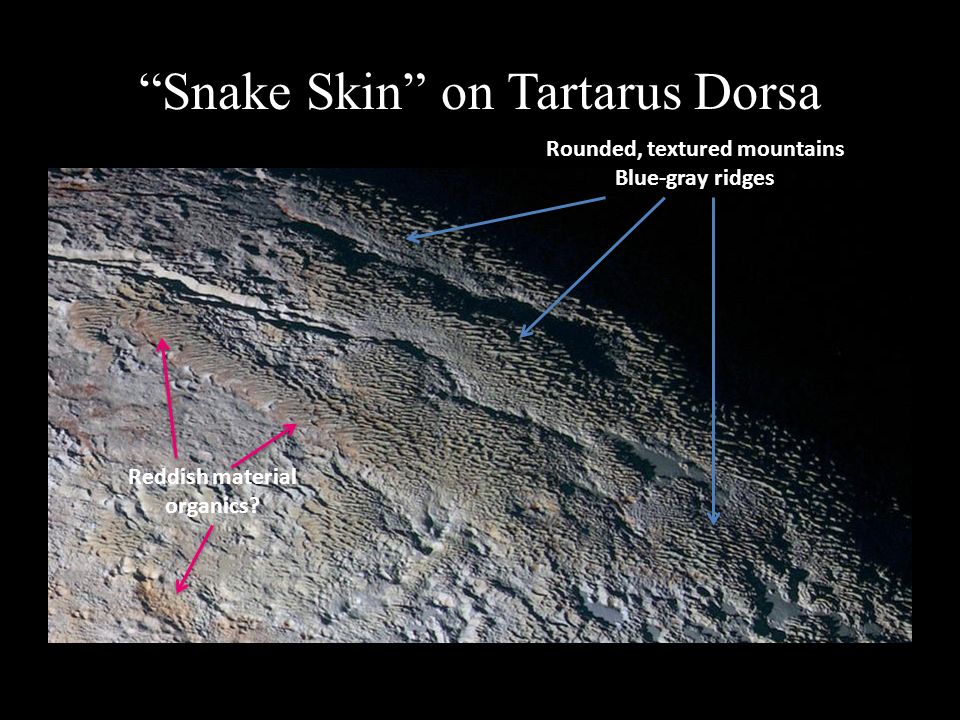
| Fig. 1: Tartarus Dorsa, originally described as a snake-skin structureNASA/JHU-APL/SwRI |
First: The finding as such is not quite so new any more. The supposition that the region of Tartarus Dorsa on Pluto (fig. 1) might constitute an extraterrestrial equivalent of nieve penitentes has already been mentioned in our book Pluto & Charon, June, 2016. The news about it is the digital simulation by Moores et al. that has confirmed in December 2016 what had been but mere speculation in spring.
In the Alps or in the Pyrenees, you would not find any nieve penitentes because it is restricted to high mountains close to the equator, such as the Andes, Mount Kilimanjaro, the Elbruz or the Himalayas. The air must be very dry and very cold - maybe also very low-pressure? - to reduce layers of ice sublimating in sunlight to structures that grow most frequently up to 0.5 to 1.5 metres and to a few decimeters in width, though occasionally they may tower as high as six metres. They are arranged in regular spaces following the prevailing direction of irradiation. Mountaineers know this phenomenon also as ice spikes or ice blades. Despite its outward beauty, particularly when the moon is out, it is little popular because it is difficult to tread on and complicates making headway.
![]() |
| Fig. 2: Nazarenos as a model for snow penitents By Pedro J Pacheco (Own work) [CC BY-SA 4.0], via Wikimedia Commons |
Ice blades have not been named by painter Rudolf Reschreiter, as you often may read these days, but by mountaineer Dr Paul Güssfeldt who first discovered them on Mount Aconcagua in 1883. In the Deutsche Rundschau journal, vol. 42, 1885, Güssfeldt recalled that he was first tempted to refer to the head-high ice spikes, 'which deserve to be introduced to science by a special term' as 'Kerzenfelder', candle fields,'until [mountain guide Lorenzo] Zamorano gave the better word nieve de los penitentes, or nieve penitente, "snow penitents", into my hand.' Lorenzo Zamorano was obviously reminded of the white pointed hoods of the nazarenos, the penitents of processions of the Spanish Catholic church (fig. 2). The term, nieve penitentes, was plainly claimed as the 'international name' of the phenomenon by the Popular Science journal in December 1917.
Concerning visuals, however, it was indeed Rudolf Reschreiter (* 1868; † 1939) who popularised snow penitents when he travelled the Cordilleras in 1903, in the wake of Prof Hans Meyer. On 12 July, Reschreiter discovered ice blades on the west slope of Mount Chimborazo, took photos (image 3) and converted them later into naturalistic paintings that Prof Meyer used to illustrate his 1907 book In den Hoch-Anden von Ecuador: Chimborazo, Cotopaxi, etc. One of these paintings is now on display in the Alpenvereinsmuseum Innsbruck.
![]() |
| Fig. 3 Ice blades rendered by R. Reschreiter in 1907 |
Neither Güssfeldt nor Meyer were able to explain the origin of snow penitents beyond the obvious, namely that wind and sun had to be involved in some way or another. In 1917, Popular Science even smugly fell back on precipitated grains of 'meteor' dust to explain why ice blades should stay behind when a glacier was melting away. It was not before a hundred years later, in 2007, when a team led by M. D. Betterton finally managed to generate small-scale snow penitents in the lab:
'In nature, these spikes develop every year anew when tiny bumps on a surface of fresh snow scatter sunlight inside. More light causes more snow to evaporate, or sublimate - owing to the dryness of the air, the solid-state snow transforms into vapour. The process is accumulative: the depressions become deeper and deeper and, hence, can "trap" more and more sunlight, so that at the end there are deep troughs between which those ice spikes have remained. In winter, when the sun is less powerful, fresh snowfall fills in the troughs, so that in spring, another level surface will welcome the sun. The spikes protect the glacier surface in two ways: On the one hand, they cast shadows so that less surface is exposed to the sun. On the other hand, their three-dimensional structure multiplies the available surface of the glacier - providing more surface for heat exchange, and cold mountain winds can cool the ice more effectively.
To accelerate the process, Betterton's team had spread toner particles from a photocopier on fresh blocks of snow. If the particles were spread thin enough to let light pass to the ice, troughs developed there as well. The toner particles then protected the ice spikes against irradiation and you had to wait only half an hour, rather than three hours, for "ice blade forests" to develop.' (Was this approach inspired by the 'meteor' dust hypothesis?)
(Translated from Welt der Physik)
This model had a drawback, though: it still failed to explain why the ice blades would be set in regular spaces and turned parallel to each other. A study published by Philippe Claudin in 2015 helped explain this:
'Regarding the characteristic spacing of these troughs, Claudin and his colleagues found that vapour diffusion at the surface is essential. It" see only when there ares significant local variations in the vapour contents of the air precisely above the surface that one part of the surface can sublimate quicker than another. But lateral diffusion [by wind] suppresses look thus if this diffusion is almost, discrete penitentes can only grow a long distance striking. In other Word, the separation of the penitentes increases with the diffusion advises.'
However, the structures in Tartarus Dorsa on Pluto are very different from those on Earth. Firstly, they are arranged not in one but in three different directions, interpreted by Moores et al. as a sign of high age, while ice blades on Earth do not survives even a full year: Pluto must have changed its orbital parameters several times while they were growing. Secondly, they are overwhelmingly gigantic: Made of frozen methane rather than water ice, they are not restricted to Reschreiter's hip-high spikes but grow to pillars that loom up to 500 metres and stand so far apart that you could squeeze a colony in between!
A viewer on the surface of Pluto must consider Tartarus Dorsa a wonder of nature that only the most daring SF authors might have imagined. Maybe this description comes closest that Stanislaw Lem gave of the fictive Wood of Birnam on Saturn's moon Titan in his novel Fiasco (1985): 'The furious play of chemical radicals … created a crusty porcelain jungle that atteined heights of a quarter of a mile; the weak gravitation assisted its growth, so that there were treelike formations and thickets of glassy white laid upon each other in successive layers. … The enormous bulk was actually a solidified cloud formed of spiderweb capillaries in every shade of white, from pearly opalescent to dazzling milky.' It would be worth knowing whether snow penitents may also occur under the conditions prevailing on Titan - may this explain the remarkably bright features of the landscape of Xanadu?
Now here is a challenge for you artist illustrators: What would the ice spike forests of Tartarus Dorsa look like for astronauts landed on the ground?
Codex Regius, in January 2017
Abonnieren
Posts (Atom)