Seiten

What is this about

This blog collects supplemental data on lesser worlds of the solar system (like Pluto and Titan) that have not (yet) been included in our books. You may contribute to our blog with brief articles that we will on your request also translate for our monolingual audience. The only precondition: Your content must in some way relate to dwarf planets or large moons of the solar system.

Send your text to: i n f o (youknowwhichsign) c o d e x - r e g i u s . e u

Ebooks: Download for Kindle Print: Order our printed books from CreateSpaceOrder our printed books from Amazon
Codex Regius on/auf: TwitterFacebookVKGoogle +1youtubetumblr
Posts mit dem Label eng werden angezeigt. Alle Posts anzeigen

Freitag, 19. Januar 2018

NEW: Enceladus - Iceland of Space

Among the moons of the ringed planet, Saturn, little Enceladus was the primary target of the Cassini space probe other than huge Titan. And for good reason: Apart from Jupiter’s moon Europa, Enceladus is these days considered the most promising target in the quest for extraterrestrial life in the solar system. In this respect, the moons and dwarf planets of the outer solar system have left long-favoured planet Mars behind by now.
  Only the last ten years have made evident to us that cold worlds need not be frozen to the core and inanimate. Traces of past or even present activities like earthquakes, geysers, eruptions, snowfalls or even tidal surges can be found on locations from the innermost dwarf planet Ceres to its big brother Pluto far away behind the orbits of the large Jovian giants.
  NASA has made it a habit to claim ‘oceans’ in the netherworlds of icy bodies in and beyond the planetoid belt wherever it looks. It may sound encouraging at press conferences because it makes many an audience think of fish, jellyfish and coral. On Enceladus, alleged ‘geysers’ even spray water vapour into the sky, evoking mental images of the Yellowstone National Park, of Iceland or just of Andernach in Germany. Textbook articles, on the other hand, often refer more reservedly to those briny waters inside lesser worlds of the solar system as ‘liquid mantles’.
  Both approaches are justifiable, depending on whether you prefer to think in terms associated with water, like a biologist does, or rather like a physicist or volcanologist who prefers to emphasise the analogy of dynamic processes developing on Earth and elsewhere.
  We use the latter approach in this book. That way, dynamic phenomena on Enceladus can be described more succinctly, elaborating on the similarities with planets like Earth. For like our homeworld, this minor body is divided into a solid shell, a liquid mantle and, again, a solid core. The geysers, as we will see, closest resemble fissure vents of Iceland hurling molten lava up in long curtains of fire. It seems justified to call Enceladus the Iceland of Space: an Iceland of ice, water and vapour.
  Ice plays the role of basalt there, water assumes the role of magma. Volcanologists like to use terms such as cryovolcanism, cryomagma and cryolava to emphasise the differences in chemistry, while the physics stay the same.
  Given all the media attention Enceladus has received as the Cassini-Huygens spacecraft crisscrossed Saturn’s system from 2005 to 2017, we find it surprising that no book publisher has so far taken on this fascinatingly exotic world that looks like the backdrop of an imaginative sci-fi film.
  In view of the continuing success of our previous books on lesser worlds of the solar system: ‘Pluto & Charon’, ‘Titan - Pluto’s big brother’ and ‘Ceres - Pluto’s little sister’, we have therefore decided to close this gap in the German- and English-speaking markets. Readers who would like to penetrate deeper into the subject are encouraged to read forthcoming ‘Enceladus and the Icy Moons of Saturn’ (ISBN: 0816537070) scheduled to be published in the USA in June 2018 and aiming at the professional audience. Regarding our own series we would like to draw special attention to the ‘Titan’ volume, because it deals with elements of the Cassini-Huygens mission alluded to but not specified in this book.

Print or eBook: Enceladus - Iceland of Space
Sample chapters: Enceladus - Iceland of Space

Donnerstag, 22. Juni 2017

Free kindle edition of "Ceres: Pluto's little sister" provided for a limited time

"Like the Lonely Mountain Erebor in J. R. R. Tolkien's mythology, Ahuna Mons on Ceres was once occupied by a dragon, but one that 'breathed' ice, not fire."
- Bill Steigerwald, Goddard Space Flight Center
The Lonely Mountain is unique on Ceres and, matter of fact, in the entire solar system. Unfortunately, it had not been treated yet in any book, that's why we have published one ourselves. Three members of the Astronomical Society Urania Wiesbaden have joined to compile what we know about this minor world - the latest article referenced was published five days before this book!
In our latest campaign, the English Kindle edition will be available for free from Friday, June 22, to Sunday, June 24. The large-format full-colour printed edition is available from Amazon, Createspace and related services.
The live video recording of our latest public lecture on Ceres (in German) is available here:


Dienstag, 13. Juni 2017

Celestial Police looking for clouds in Pluto's atmosphere


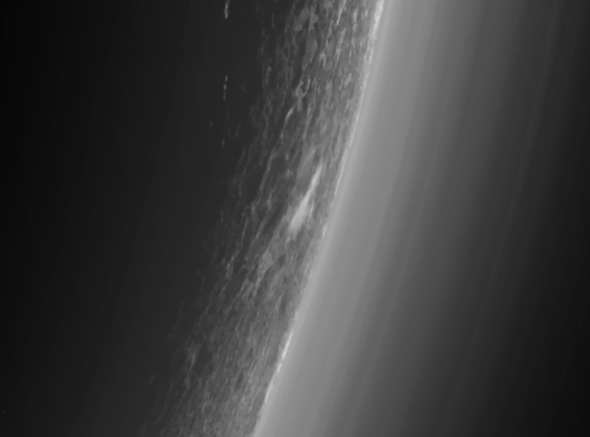
Evidence for Possible Clouds in Pluto's Present Day Atmosphere describes "a search for discrete could features in Pluto's atmosphere using New Horizons data obtained on 14-15 July 2015, during the Pluto flyby closest approach. We report that Pluto's present day atmosphere is at least largely (>99% by surface area) free of discrete clouds. We also report a handful of features that may plausibly be clouds, all of which were detected obliquely and at high phase observing geometry. No cloud candidates were identified away from the terminators or in low phase (backscattering geometry) images."

Mittwoch, 19. April 2017

New release: "Ceres: Pluto's little sister"

When at New Year’s eve of 1801 - the first night of the new century - Guiseppe Piazzi watched through his telescope and saw a tiny point of light that no star map had registered, he could hardly gave anticipated how, by this discovery, he revolutionised our understanding of the structure of our solar system.
Up to then, only the sun, seven planets (the planet Uranus had been discovered by F. W. Herschel as late as 1781), their moons and a few comets had been known. When Ceres was discovered, it was first considered a comet, then it was classified as a planet. It was supposed that Ceres was that very world that had been predicted by astronomers for long to fill the gap between Mars and Jupiter. Within a short time, Pallas, Juno and Vesta were also discovered, that orbit in the same gap between Mars and Jupiter. Thus our planetary system grew to 11 planets. 38 years went by, however, until Astraea was found in 1845 (also between Mars and Jupiter), followed by Neptune in the year after. Now we reckoned even 13 planets.
When in 1847, the first detection of Hebe initiated a deluge of new discoveries, the true nature of these objects between Mars and Jupiter was finally acknowledged, and scientists coined the terms asteroids, planetoids or minor planets for them, took them out of the list of planets and numbered them by order of discovery, beginning with (1) Ceres. Now there were only eight major planets left, including Uranus and Neptune, while the number of minor planets steadily grew. When Clyde Tombaugh discovered Pluto in the vastness beyond Neptune in 1930, it was listed as a ninth planet.
Only sixty years after, in the nineties of the last century, evidence was found that the asteroid belt between Mars and Jupiter was paired with another belt of minor solar system bodies beyond Neptune, now called the Kuiper Belt. The objects there consist mainly of ice, mixed with silicates and organic compounds. Some of them are wider than 1000 km, meaning they are larger than Ceres. And only then it became obvious that Pluto is nothing else than another of these bodies, now called TNOs (Trans-Neptunian Objects) or KBOs (Kuiper Belt Objects).
In summer 2006, the International Astronomical Union, or IAU, during its general assembly in Prague decided for a new definition of the term planet. Since then, a planet of the sun has to meet two criteria: 1.) It must be in hydrostatic equilibrium on account of its gravity, i. e. be spherical. 2.) It must be the dominating object in its sphere of influence and have its orbit cleared of other objects.
Though Pluto is perfectly spherical, as the images of the New Horizons space probe have impressively shown us, it fails on the other criterion, because it shares its orbit, intersecting that of Neptune, with about a third of the newly discovered TNOs. Therefore Pluto was no more a planet. Not to degrade it too lowly, however, a new category was designed for it: the dwarf planets. Though they must fulfil the first criterion, to be spherical, they may share similar orbits with a variety of objects. Within the scope of this new definition, spherical Ceres, reckoned as a minor planet for 150 years, has suddenly become a dwarf planet.
Ceres is the largest body is in the asteroid belt between Mars and Jupiter. With a diameter of 1000 km, it is about twice as wide as the next largest asteroids, Pallas and Vesta. About one third of the total mass of the asteroid belt is included in the mass of Ceres.
Once it had been believed that the asteroids were fragments of a larger planet that had orbited between Mars and Jupiter and burst in a cosmic disaster. This hypothetical planet, however, could not have been very big: If you could assemble all the minor bodies of the asteroid belt on Ceres, its diameter would grow only by about half its current size. The asteroid belt simply does not contain enough material to provide for a larger planet. Its total mass amounts only to about half a thousandth that of Earth or about 4 % of the mass of our Moon. In the early stage of the solar system, the gravity of the rapidly growing proto-Jupiter had sucked too much material away from this area so that no proper planet could have developed there. Ceres is only a protoplanet that had not been given a chance to accrete into a true planet.
To understand these processes better, that is why the Dawn mission had been launched. (The name was chosen as a reference to the dawn of the solar system because the mission was intended to provide us insight into the origin of planets.) The camera on board of Dawn has been built in Germany, by the same team that had been in charge of the camera on the comet probe Rosetta. It is a masterpiece of German engineering that should make us proud and the product of long-standing experience with cameras on probes like Giotto or Mars Express. This should be underlined in an era of receding space budgets and fading interest in natural sciences. The camera has not only produced marvellous images of Ceres but, in the end, even saved the continuation of the Dawn mission because, when the US administration had stopped the Dawn project because it was surpassing the budgetary limit, it was just this international cooperation that yet kept the project alive.
Join a fascinating trip to Ceres in this book by Andreas Möhn and Metka Klemenčič with its impressive images: to a body that has not fully managed to become a true planet and has been caught in the protoplanetary stage yet given us thereby important knowledge about the dawn of our solar system and the origin of our own planet.
Dr Rainer Riemann
Heidelberg, in March 2017

The English translation is online and available for a sample read:
https://www.academia.edu/32503897/Leseprobe_Ceres_GB.pdf
The complete printed book is available here: https://www.amazon.com/dp/1545462933/ref=sr_1_1…

Donnerstag, 6. April 2017

Ceres' Temporary Atmosphere Linked to Solar Activity

Diese Publikation hat es nicht mehr in unser Buch geschafft. Wir merken es an dieser Stelle für die zweite Auflage vor:
This publication did not make it into the book any more. We record it here for inclusion in a future second edition.

Ceres' Temporary Atmosphere Linked to Solar Activity


Sonntag, 29. Januar 2017

Do we need a class of "Plutonian" planets?

Abstract:
The physical and chemical characteristics of dwarf planets and large moons of the gas giants have suggested to the authors to question the present differentiation. Instead of classifying by orbits only, the structure of the worlds should be stronger weighted and distinct classes be developed that may include worlds as similar to each other as Pluto, Triton and Titan. The article suggests that the obsolete term secondary planets might be revived for moons in hydrostatic equilibrium.

Keywords:
Pluto, Charon, Titan, Ceres, Triton, dwarf planets, moons, Tholin


Montage by Emily Lakdawalla. Data from NASA / JPL, JHUAPL/SwRI, SSI, and UCLA / MPS / DLR / IDA,
processed by Gordan Ugarkovic, Ted Stryk, Bjorn Jonsson, Roman Tkachenko, and Emily Lakdawalla.

Do we need a new definition of our moons?

The year 2015 has initiated a scientific revolution whose scope we have not fully grasped yet. With Ceres and Pluto, two dwarf planets have been visited by unmanned spacecraft at the same time. Their findings suggest to us to question the present division of solar system objects.
When it is said today that Ceriesi was an intruder to the asteroid belt that has developed farther out in the solar system, should it not to be reckoned then with the icy worlds of the Kuiper Belt [1]? Watching how alike to each other are the chemical, physical and even geographical properties of Pluto and Saturn's moon Titan [2] (they have virtually the same density, to begin with), is it still justified to sort them into two different classes for the sole reason that one of them orbits a larger body and the other, a smaller one?

It might be more sensible to classiy objects in the solar system based on their planetological characteristics instead of merely their orbits. We have made a good beginning with "terrestrial" and "Jovian" planets, a little bit less fortunate we have been with the introduction of the dwarf planets. In our opinion, we need a similar division for our moons that include common classes for objects with similar properties.


But not "dwarf planets", please! I couldn't call Titan in good conscience a dwarf though it is larger than Mercury.

That's one of the problems with the definition of the International Astronomical Union: Ceres is more or less the tiniest object that may still pass as a dwarf planet, but they have failed to define an upper limit. How big does a dwarf planet have to grow to become a proper planet? Basically we believe that everything should be covered by the umbrella term "planet" that, according to the applying definition, is in hydrostatic equilibrium, regardless of what it orbits around.

In other words, everything that is more or less round.

Though at least Haumea poses a major problem here! But with regard to the big moons we suggest reviving the obsolete expression secondary planets (first used by Newton, I think) for moons in hydrostatic equilibrium that has been in common use for any moons satellites in the solar system in the 18th and 19th centuries. It fell into disuse, it seems, when the moons of Mars were discovered because it felt too awkward to call those two potatoes planets. As a result, we would have five terretesrial planets in the inner solar system: as before, the four primary planets Mercury to Mars, and one secondary planet, the Moon. The class of Jovian planets stays the same. Then, a new category should follow for ice/tholin worlds like Titan, Triton and Pluto.

Or a more general one, for planets with icy crust and liquid water mantle? That would also cover the dwarf planet Ceres or other active secondary planets like Enceladus.

That might be worth consideration. This category could be dubbed Plutonian planets, to cool some moods across the Pond, [3], even though from the historical point of view, Titan was the first discovered, and prototype, of the big ice planets.

What about the Galilean Moons?

We are undecided about whether they should be included. Io is definitely a case apart. Especially Callisto may absolutely belong into the same category, because its density is also comparable to that of Pluto. What do our readers think? We are waiting for your suggestions!

Postscriptum 2016-02-08: Such a proposal seems to actually have been made, see Six New Horizons scientists propose geophysical planet definition by L. Kornfeld. I do not like the term "moon planet" much because it is hard to translate into other languages. Planète lunaire for French is already occupied by the meaning "planet looking like the moon", i.e. Mercury, Mondplanet for German, though better than "Satellitenplanet", is commonly understood as referring to inhabited SF moons (like Endor or Pandora), meaning that verbatim translations will lead to a lot of avoidable confusion. I am sure we can come up with something better than that. French astronomers of the 19th cntury also used the term planètes subalternes, what about that?

[1] Möhn/Klemenčič/Riemann (Codex Regius): „Ceres - Pluto's little sister“, Wiesbaden/Ljubljana 2017 (prep.)

[2] Möhn/Klemenčič/Riemann (Codex Regius): „Titan - Pluto's big brother“, Wiesbaden/Ljubljana 2016

[3] Möhn/Klemenčič/Riemann (Codex Regius): „Pluto & Charon“, Wiesbaden/Ljubljana 2016

Mittwoch, 28. Dezember 2016

Titan: Pluto's big brother - The Cassini-Huygens spacecraft and the darkest moon of Saturn

My little Christmas present for myself: I have just released the English-language version of our non-fiction book on Saturn's moon Titan, the second installment in our series on lesser worlds of the solar system after "Pluto & Charon". 
Adding the subtitle "Pluto'sbig brother" was a late thought when I realised that the similarities between the two bodies are so distinct that they ought to be attributed to the same class of (dwarf) planets, of which I made a point in the book:
Plutonian worlds, besides Terrestrial and Jovian? For one thing, Pluto and Titan have the same density, the same materials (though some of them in different phases), and looking at Pluto helps a lot to understand Titan, too. And why do both of them have a desert belt made of  precipitated tholin, both with a major disruption: Sputnik Planum/Planitia vs. Xanadu? So, essentially, is Titan a bigger and warmer Pluto?
Look forward to our third installment that is already scheduled with a lecture in May.

Sample pages can be read on Academia.edu .


Order here