Seiten

What is this about

This blog collects supplemental data on lesser worlds of the solar system (like Pluto and Titan) that have not (yet) been included in our books. You may contribute to our blog with brief articles that we will on your request also translate for our monolingual audience. The only precondition: Your content must in some way relate to dwarf planets or large moons of the solar system.

Send your text to: i n f o (youknowwhichsign) c o d e x - r e g i u s . e u

Ebooks: Download for Kindle Print: Order our printed books from CreateSpaceOrder our printed books from Amazon
Codex Regius on/auf: TwitterFacebookVKGoogle +1youtubetumblr
Posts mit dem Label engl werden angezeigt. Alle Posts anzeigen

Freitag, 19. Januar 2018

NEW: Enceladus - Iceland of Space

Among the moons of the ringed planet, Saturn, little Enceladus was the primary target of the Cassini space probe other than huge Titan. And for good reason: Apart from Jupiter’s moon Europa, Enceladus is these days considered the most promising target in the quest for extraterrestrial life in the solar system. In this respect, the moons and dwarf planets of the outer solar system have left long-favoured planet Mars behind by now.
  Only the last ten years have made evident to us that cold worlds need not be frozen to the core and inanimate. Traces of past or even present activities like earthquakes, geysers, eruptions, snowfalls or even tidal surges can be found on locations from the innermost dwarf planet Ceres to its big brother Pluto far away behind the orbits of the large Jovian giants.
  NASA has made it a habit to claim ‘oceans’ in the netherworlds of icy bodies in and beyond the planetoid belt wherever it looks. It may sound encouraging at press conferences because it makes many an audience think of fish, jellyfish and coral. On Enceladus, alleged ‘geysers’ even spray water vapour into the sky, evoking mental images of the Yellowstone National Park, of Iceland or just of Andernach in Germany. Textbook articles, on the other hand, often refer more reservedly to those briny waters inside lesser worlds of the solar system as ‘liquid mantles’.
  Both approaches are justifiable, depending on whether you prefer to think in terms associated with water, like a biologist does, or rather like a physicist or volcanologist who prefers to emphasise the analogy of dynamic processes developing on Earth and elsewhere.
  We use the latter approach in this book. That way, dynamic phenomena on Enceladus can be described more succinctly, elaborating on the similarities with planets like Earth. For like our homeworld, this minor body is divided into a solid shell, a liquid mantle and, again, a solid core. The geysers, as we will see, closest resemble fissure vents of Iceland hurling molten lava up in long curtains of fire. It seems justified to call Enceladus the Iceland of Space: an Iceland of ice, water and vapour.
  Ice plays the role of basalt there, water assumes the role of magma. Volcanologists like to use terms such as cryovolcanism, cryomagma and cryolava to emphasise the differences in chemistry, while the physics stay the same.
  Given all the media attention Enceladus has received as the Cassini-Huygens spacecraft crisscrossed Saturn’s system from 2005 to 2017, we find it surprising that no book publisher has so far taken on this fascinatingly exotic world that looks like the backdrop of an imaginative sci-fi film.
  In view of the continuing success of our previous books on lesser worlds of the solar system: ‘Pluto & Charon’, ‘Titan - Pluto’s big brother’ and ‘Ceres - Pluto’s little sister’, we have therefore decided to close this gap in the German- and English-speaking markets. Readers who would like to penetrate deeper into the subject are encouraged to read forthcoming ‘Enceladus and the Icy Moons of Saturn’ (ISBN: 0816537070) scheduled to be published in the USA in June 2018 and aiming at the professional audience. Regarding our own series we would like to draw special attention to the ‘Titan’ volume, because it deals with elements of the Cassini-Huygens mission alluded to but not specified in this book.

Print or eBook: Enceladus - Iceland of Space
Sample chaptersEnceladus - Iceland of Space

Donnerstag, 22. Juni 2017

Free kindle edition of "Ceres: Pluto's little sister" provided for a limited time

"Like the Lonely Mountain Erebor in J. R. R. Tolkien's mythology, Ahuna Mons on Ceres was once occupied by a dragon, but one that 'breathed' ice, not fire."
- Bill Steigerwald, Goddard Space Flight Center
The Lonely Mountain is unique on Ceres and, matter of fact, in the entire solar system. Unfortunately, it had not been treated yet in any book, that's why we have published one ourselves. Three members of the Astronomical Society Urania Wiesbaden have joined to compile what we know about this minor world - the latest article referenced was published five days before this book!
In our latest campaign, the English Kindle edition will be available for free from Friday, June 22, to Sunday, June 24. The large-format full-colour printed edition is available from Amazon, Createspace and related services.
The live video recording of our latest public lecture on Ceres (in German) is available here:


Dienstag, 13. Juni 2017

Celestial Police looking for clouds in Pluto's atmosphere


Evidence for Possible Clouds in Pluto's Present Day Atmosphere describes "a search for discrete could features in Pluto's atmosphere using New Horizons data obtained on 14-15 July 2015, during the Pluto flyby closest approach. We report that Pluto's present day atmosphere is at least largely (>99% by surface area) free of discrete clouds. We also report a handful of features that may plausibly be clouds, all of which were detected obliquely and at high phase observing geometry. No cloud candidates were identified away from the terminators or in low phase (backscattering geometry) images."

Dienstag, 10. Januar 2017

The ice spike forests of Pluto: What the heck are penitentes?

Astronomy websites are spreading the news these days that an icy structure called 'nieve penitentes' has been confirmed for Pluto, of a kind known from the high mountains of South America, and that a computer simulation had shown where it came from. Alas, many commenters were not too familiar with the concept and got the details wrong. The following contribution tries to explain what kind of a phenomenon is really behind the nieve penitentes, or snow penitents.

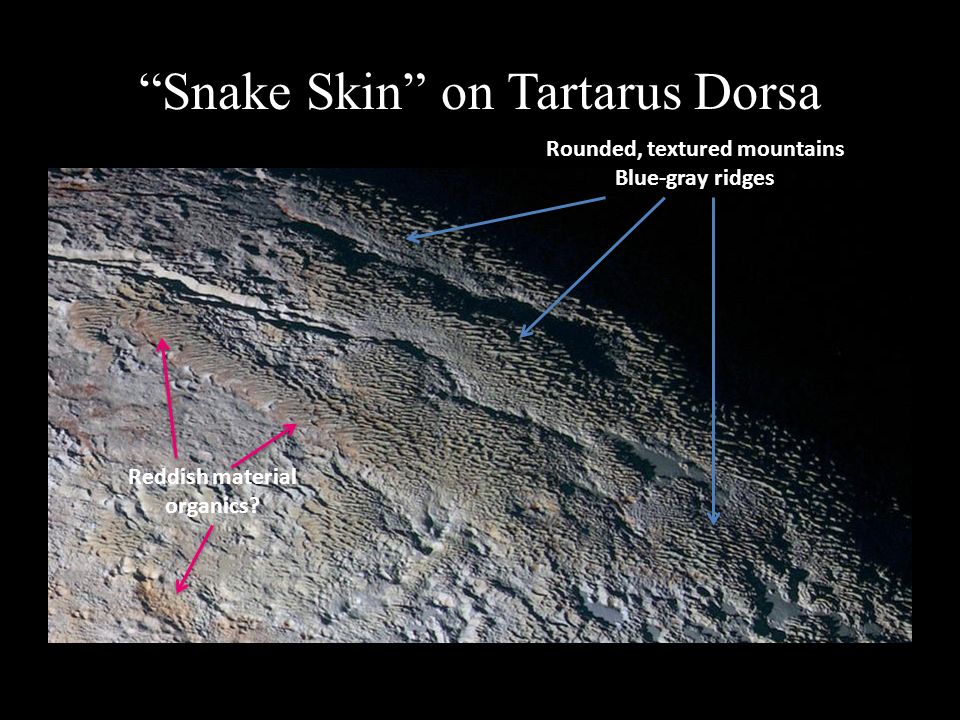
Fig. 1: Tartarus Dorsa, originally
described as a snake-skin structureNASA/JHU-APL/SwRI
First: The finding as such is not quite so new any more. The supposition that the region of Tartarus Dorsa on Pluto (fig. 1) might constitute an extraterrestrial equivalent of nieve penitentes has already been mentioned in our book Pluto & Charon, June, 2016. The news about it is the digital simulation by Moores et al. that has confirmed in December 2016 what had been but mere speculation in spring.

In the Alps or in the Pyrenees, you would not find any nieve penitentes because it is restricted to high mountains close to the equator, such as the Andes, Mount Kilimanjaro, the Elbruz or the Himalayas. The air must be very dry and very cold - maybe also very low-pressure? - to reduce layers of ice sublimating in sunlight to structures that grow most frequently up to 0.5 to 1.5 metres and to a few decimeters in width, though occasionally they may tower as high as six metres. They are arranged in regular spaces following the prevailing direction of irradiation. Mountaineers know this phenomenon also as ice spikes or ice blades. Despite its outward beauty, particularly when the moon is out, it is little popular because it is difficult to tread on and complicates making headway.

Fig. 2: Nazarenos as a model for snow penitents
By Pedro J Pacheco (Own work) [CC BY-SA 4.0],
via Wikimedia Commons
Ice blades have not been named by painter Rudolf Reschreiter, as you often may read these days, but by mountaineer Dr Paul Güssfeldt who first discovered them on Mount Aconcagua in 1883. In the Deutsche Rundschau journal, vol. 42, 1885, Güssfeldt recalled that he was first tempted to refer to the head-high ice spikes, 'which deserve to be introduced to science by a special term' as 'Kerzenfelder', candle fields,'until [mountain guide Lorenzo] Zamorano gave the better word nieve de los penitentes, or nieve penitente, "snow penitents", into my hand.' Lorenzo Zamorano was obviously reminded of the white pointed hoods of the nazarenos, the penitents of processions of the Spanish Catholic church (fig. 2). The term, nieve penitentes, was plainly claimed as the 'international name' of the phenomenon by the Popular Science journal in December 1917.

Concerning visuals, however, it was indeed Rudolf Reschreiter (* 1868; † 1939) who popularised snow penitents when he travelled the Cordilleras in 1903, in the wake of Prof Hans Meyer. On 12 July, Reschreiter discovered ice blades on the west slope of Mount Chimborazo, took photos (image 3) and converted them later into naturalistic paintings that Prof Meyer used to illustrate his 1907 book In den Hoch-Anden von Ecuador: Chimborazo, Cotopaxi, etc. One of these paintings is now on display in the Alpenvereinsmuseum Innsbruck.

Fig. 3 Ice blades rendered by
R. Reschreiter in 1907
Neither Güssfeldt nor Meyer were able to explain the origin of snow penitents beyond the obvious, namely that wind and sun had to be involved in some way or another. In 1917, Popular Science even smugly fell back on precipitated grains of 'meteor' dust to explain why ice blades should stay behind when a glacier was melting away. It was not before a hundred years later, in 2007, when a team led by M. D. Betterton finally managed to generate small-scale snow penitents in the lab:

'In nature, these spikes develop every year anew when tiny bumps on a surface of fresh snow scatter sunlight inside. More light causes more snow to evaporate, or sublimate - owing to the dryness of the air, the solid-state snow transforms into vapour. The process is accumulative: the depressions become deeper and deeper and, hence, can "trap" more and more sunlight, so that at the end there are deep troughs between which those ice spikes have remained. In winter, when the sun is less powerful, fresh snowfall fills in the troughs, so that in spring, another level surface will welcome the sun. The spikes protect the glacier surface in two ways: On the one hand, they cast shadows so that less surface is exposed to the sun. On the other hand, their three-dimensional structure multiplies the available surface of the glacier - providing more surface for heat exchange, and cold mountain winds can cool the ice more effectively.

To accelerate the process, Betterton's team had spread toner particles from a photocopier on fresh blocks of snow. If the particles were spread thin enough to let light pass to the ice, troughs developed there as well. The toner particles then protected the ice spikes against irradiation and you had to wait only half an hour, rather than three hours, for "ice blade forests" to develop.
' (Was this approach inspired by the 'meteor' dust hypothesis?)
(Translated from Welt der Physik)

This model had a drawback, though: it still failed to explain why the ice blades would be set in regular spaces and turned parallel to each other. A study published by Philippe Claudin in 2015 helped explain this:

'Regarding the characteristic spacing of these troughs, Claudin and his colleagues found that vapour diffusion at the surface is essential. It" see only when there ares significant local variations in the vapour contents of the air precisely above the surface that one part of the surface can sublimate quicker than another. But lateral diffusion [by wind] suppresses look thus if this diffusion is almost, discrete penitentes can only grow a long distance striking. In other Word, the separation of the penitentes increases with the diffusion advises.'

However, the structures in Tartarus Dorsa on Pluto are very different from those on Earth. Firstly, they are arranged not in one but in three different directions, interpreted by Moores et al. as a sign of high age, while ice blades on Earth do not survives even a full year: Pluto must have changed its orbital parameters several times while they were growing. Secondly, they are overwhelmingly gigantic: Made of frozen methane rather than water ice, they are not restricted to Reschreiter's hip-high spikes but grow to pillars that loom up to 500 metres and stand so far apart that you could squeeze a colony in between!

A viewer on the surface of Pluto must consider Tartarus Dorsa a wonder of nature that only the most daring SF authors might have imagined. Maybe this description comes closest that Stanislaw Lem gave of the fictive Wood of Birnam on Saturn's moon Titan in his novel Fiasco (1985): 'The furious play of chemical radicals … created a crusty porcelain jungle that atteined heights of a quarter of a mile; the weak gravitation assisted its growth, so that there were treelike formations and thickets of glassy white laid upon each other in successive layers. … The enormous bulk was actually a solidified cloud formed of spiderweb capillaries in every shade of white, from pearly opalescent to dazzling milky.' It would be worth knowing whether snow penitents may also occur under the conditions prevailing on Titan - may this explain the remarkably bright features of the landscape of Xanadu?

Now here is a challenge for you artist illustrators: What would the ice spike forests of Tartarus Dorsa look like for astronauts landed on the ground?

Codex Regius, in January 2017

Donnerstag, 15. September 2016

"Pluto & Charon" - now for the last time for free!


For the last time before it will drop out of KDP Select, we offer the English kindle-version of "Pluto & Charon" for free. You may download the latest eBook file on either Friday, 16 or Saturday, 17, from here: https://www.amazon.com/Pluto-Charon-Horizons-spacecraft-farthest/dp/1534960740 and see for yourself what the printed edition would look like if you had it lying on your desk.
The eBook edition will be made available for ePub-readers as well on 1 October, 2016.


"In this book its two authors have managed to present the intriguing results of New Horizons’ Pluto flyby in a mode that non-professionals will understand, without waiving appropriate scientific accuracy."
(Dr. R. Riemann, astrophysicist, University of Heidelberg, Germany)

 #Pluto #Newhorizons #Solarsystem #NASA

Sonntag, 14. August 2016

How Clyde Tombaugh would have seen Pluto

(c) Codex Regius

This is how Clyde Tombaugh would have seen Pluto on 23 Januar 1930 if he had access to a telescope with the capacity of Hubble. Note that Pluto's southern hemisphere that New Horizons has not been able to map was turned to him, hence, a more detailed resolution cannot be simulated. Dark Cthulhu Regio at the lower edge is clearly discernible, however.

The image was created with the Celestia 1.6.1 software and digitally processed.

Montag, 25. Juli 2016

An ammonia-water slurry may swirl below Pluto's icy surface

And another lucky strike for Edmond Hamilton? He has made this proposal in 1940, too, to explain a fictitious liquid ocean - Avernus Mare - on his vision of Pluto; just that his argument was based on salt, not ammonia.


Pluto’s Surface ​May Be Alive Thanks To Planetary Antifreeze

Sonntag, 24. Juli 2016

"Pluto & Charon" still available for free - running out!

Nix, Pluto and Charon, enhanced image computed by Celestra 1.6.1
Just a few hours left to download the ebook version of our "Pluto & Charon" pictorial volume from kdp and/or Amazon for free! The printed edition, published in June 2016, is full-colour and US-letter-sized to display the best images taken by the New Horizons spacecraft in all their splendour. (No, I have no idea why the price in US-Dollars is so much out of proportion in comparison to Pounds and Euros. Blame Amazon for that, it's their odd calculation.)

"In this book its two authors have managed to present the intriguing results of New Horizons’ Pluto flyby in a mode that non-professionals will understand, without waiving appropriate scientific accuracy.
Pluto was discovered by Clyde Tombaugh in 1930 and stayed the only known large object in the outer solar system for more than 60 years. Then, since the 1990s, improved CCD technology helped track down more than a thousand other objects in the ‘Kuiper Belt’. The size of some of them came close to Pluto, and Eris, photographed in 2003 but escaping notice till 2005, threatened even to replace it as the biggest object in the Kuiper Belt. The result was a re-definition of the term ‘planet’ by the general assembly of the International Astronomical Union, held in Prague in summer 2006. Pluto is no longer called a planet since. From the perspective of celestial mechanics, this decision may be reasonable and logical because Pluto does something that a decent planet should not do: It crosses the orbit of another planet. The large planet Neptune has forced small Pluto and several hundred, recently discovered, smaller bodies called plutinos into a 3:2 orbital resonance by its gravitational force that avoids any collisions with Neptune.
Fortunately, half a year had already passed since the launch of the New Horizons spacecraft when the new definition of the term ‘planet’ was voted about. If Pluto had not been a planet at that time any more, some overzealous US-senators might have simply cancelled its construction to add the money saved to their military budget. (This was what had indeed happened to the Dawn spacecraft for some months.) In such a case, the wonderful close-ups of this amazing world at the very edge of the solar system would have escaped us.
With the findings of New Horizons in mind, said new definition should be reconsidered. I am sure that the voting would have had a different result if we had already known back then what New Horizons has revealed to us about Pluto. The new definition is based on celestial mechanics only and does not take Pluto’s peculiarities into account that it has from the planetologist’s point of view. It has more characteristics of a regular planet than the twice as large inner planet Mercury: While Mercury is a grey orb whose surface has primarily been shaped by impacts, New Horizons has shown us Pluto as a body with a distinctive geology of its own from far away already. There are diverse types of terrain present: mountainous areas alternate with smooth plains of nitrogen glaciers in which water icebergs are drifting about, driven to the edges of convection cells by up-welling heat; their dark summits peak out like islands.
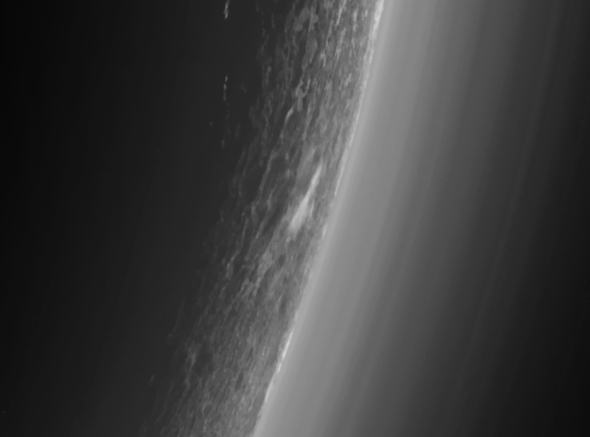
Unlike airless Mercury, Pluto does have an atmosphere that does not simply become more tenuous from inside out, but it is many-layered in the very meaning of the word: images of Pluto‘s rim reveal several banks of haze at different levels above ground. There must be some kind of weather as well. As Pluto heads on to those parts of its orbit that are remote from the sun, a part of its atmosphere will freeze out and precipitate on its surface, only to thaw again when it is back to perihelion - 200 years later. And one of the images, scientists believe, even seems to depict a cloud bank.
Moreover, Pluto has a complex satellite system comprised of five moons, and their periods resonate with each other and they are almost exact multiples of the revolutional period of the biggest moon, Charon. Compare this to the fact that Mercury and Venus have no moons at all, our Earth, one, Mars, two small ones, and among the minor planets there are only systems with up to two moons known.
Even though Pluto may not be elevated to planet status again, our solar system and the eight planets that are officially left will presumably not represent the complete image yet. During the last few years, six lesser bodies have been discovered far away whose perihelions (their points of closest approach to the sun) are located far beyond Neptune and the Kuiper Belt. And their orbits are close together in space, which may perhaps not be explained by chance alone. These objects measure less than 1,000 km in diameter, and therefore, they are certainly not proper planets. But they cannot have developed out there, in empty space. Something larger must have taken them so far out from the sun, like Neptune has set the plutinos and other objects of the Kuiper Belt on their courses.
Mike Brown, he who has initiated Pluto’s demolition by discovering almost Pluto-sized Eris, supposes that a planet may be lurking out there that has about 10 times the mass of the Earth. Such a behemoth would certainly fit the new criteria for ‘proper’ planets, and Mike Brown has already assigned the unofficial name Planet Nine to it. Based on the data of those six farthest bodies, an approximate orbit of this still hypothetical planet can be also computed. According to these values, it travels around the sun 700 times as far out as Earth and 30 times as far out as Neptune, spending about 20,000 years on one revolution. But at which point of its orbit it might be at the moment, that cannot be computed.
That this planet has not been discovered yet should not struck anyone by surprise. Since the brightness of a body decreases by the fourth power of its distance from the sun, even an object as large as Neptune would be a million times dimmer than that. Mike Brown is rather confident, however, that his Planet Nine will be detected within the next 5 to 10 years by improved sky survey programmes. Once it has been located, a spacecraft will certainly be sent to this planet, and the two authors behind the Codex Regius label are no doubt already standing ready to publish the results of this flyby in a book. If NASA should take recent plans of a laser-powered interstellar miniature probe serious, this might even happen within our lifetime.
We have waited long enough for the Pluto flyby.
But … it has been worth waiting, that you will see on the following pages!"

Dr Rainer Riemann

Heidelberg, in June 2016

Freitag, 22. Juli 2016

Pluto 1940 and today

(c) E. Hamilton/gemeinfrei*; NASA/JHUAPL/SwRI

* Note: according to Art. 72 Abs (3) UrHG, the left image
is in public domain by applying German regulations

Have you ever heard of Edmond Hamilton, the SF-author from the Golden Age? On the left is shown how he imagined Pluto - in 1940! - in his Pulp SF series "Captain Future". We see the eastern hemisphere of Pluto, discovered just 10 years before, and its three moons called Charon, Cerberus/Kerberos and Styx that, according to Hamilton, would be discovered around 1970. Charon is the largest of Pluto's fictitious moons.

Right: Images of the New Horizons spacecraft, shot in 2015, showing the eastern hemisphere of Pluto (at 270°) and its three moons Charon, Kerberos and Styx including the dates of discovery. Note the ring-shaped structure in the lower right quadrant of both images.
In his novel "Calling Captain Future", published in 1940, Hamilton described a manned landing on Pluto's surface in the light of its three moons. One of the features described are the Marching Mountains - water ice glaciers pushed across Pluto's surface at rapid speed. New Horizons found the Marching Mountains on Sputnik Planum!


This is so odd that I could not refrain from mentioning it in my lecture to the Astronomical Society Urania in March 2014 (Video recording - alas, in German only).
Hamilton's stupefying visions are fully quoted and discussed in our "Pluto & Charon" pictorial, published in June 2016, that gives an overview of the initial results of the New Horizons mission, including data from the articles published in "Science" on March 2016. 

Donnerstag, 21. Juli 2016

Pluto Articles: The Surface of Sputnik Planum must be less than 10 million years

Data from the New Horizons mission to Pluto show no craters on Sputnik Planum down to the detection limit (2 km for low resolution data, 625 m for high resolution data). The number of small Kuiper Belt Objects that should be impacting Pluto is known to some degree from various astronomical surveys. We combine these geological and telescopic observations to make an order of magnitude estimate that the surface age of Sputnik Planum must be less than 10 million years. This maximum surface age is surprisingly young and implies that this area of Pluto must be undergoing active resurfacing, presumably through some cryo-geophysical process. We discuss three possible resurfacing mechanisms and the implications of each one for Pluto’s physical properties.

Impact interval onto Sputnik Planum, Pluto, in Earth years as a function of impactor size.


The Surface Age of Sputnik Planum

"Pluto & Charon" e-book available for free - but only for two days!

This is a simulation of what Clyde Tombaugh would have seen on 23 January 1930 if he had a better telescope - say, like the Hubble. ;-) Note that he was looking at the south pole, the part not cartographed by New Horizons, hence, no better resolution is available.

And these are the positions of Pluto and its five moons on the day Tombaugh first looked at them.

The images were created with the assistance of Celestia 1.6.1 to accompany our "Pluto & Charon" pictorial volume whose e-book edition - but only the English one! - will be available for free next Saturday and Sunday, 22 and 23 July, from kdp and/or Amazon.
There is no change to the full-colour print edition (don't blame me for the seemingly forbidding price in Dollars, compared to those in Pounds and Euros - the computation was Amazon's, not mine!)

Dienstag, 19. Juli 2016

Pluto Articles: Pluto Follows Its Cold, Cold Heart

Why is Sputnik Planum exactly facing away from Charon? This article examines Pluto's dynamics and draws the astonishing conclusion that its axis may actually be unstable, owing to the relative distribution of volatile ices on the surface. So what would actually happen if Sputnik Planum would at times melt up, as we propose in our book? Is it conceivable that on such occasions it might actually "see" Charon rising one day?

Falls jemand diesen Artikel noch nicht gesehen hat: Hier diskutieren Experten, warum das Sputnik Planum genau von Charon abgewandt ist, und kommen zu dem Schluss, dass Umverteilungen der flüchtigen Eise an der Oberfläche Plutos Achse zum Taumeln bringen können. Was würde also tatsächlich geschehen, wenn das Sputnik Planum sich zeitweise verflüssigte, wie wir in unserem Buch vorschlagen? Könnte irgendwann der Charon über seinem Horizont aufgehen?

Pluto follows its cold, cold heart


Sputnik Planum, the left lobe of Pluto’s heart, is a vast expanse of mostly frozen nitrogen that lies close to the dwarf planet’s equator — too close to be mere coincidence, two UA planetary researchers suggest. So much ice has piled up here that it could have dragged the entire planet with it and reoriented its spin axis, they think. Charon is seen in the background. (Image: James Keane)

Donnerstag, 14. Juli 2016

A Death-star that Lovecraft himself must have made up

I knew this strange, grey world was not my own,
But Yuggoth, past the starry voids 

H.P. Lovecraft: Fungi from Yuggoth


What does it mean when scientists say, Charon was more than seven times larger in Pluto's sky than the Moon is in the sky of Earth? This direct comparison takes the very same setting on Earth, in Antarctica, and in the lower image relocates it into the Western "tail" of the Cthulhu Regio where Charon is still low above the horizon. 

In chapter 7 of "Pluto & Charon - The New Horizons spacecraft at the farthest worldly shores", the scene shown in the lower image is described like this:


What a sight would that be if Captain Future steered his spaceship down to the Sputnik Planum and headed westwards? On his ship races above the inviting broad nitrogen surface; then he is forced to pull steeply up when the icy islands of Baré Montes and the coastal line rising thousands of metres high behind come into view. Soon, the infinitely sombre ridges of the Cthulhu Regio march along beneath the ship. Just here and there, fresh ice glaciers flash on peaks like dewdrops. Faint sunlight just about manages to reveal the colour of the soil. it is dyed with dimly red tholin: a battlefield flooded under clotted blood, Yuggoth rather than Pluto.

   Suddenly an ashen dome looms forth behind the mountains. It grows to a disk and eventually withdraws from the western horizon, hugely blown up. This is Charon, Pluto’s repulsive brother. Seven times wider than Earth’s full moon it creeps up the sky, and no man in the moon smiles down from there. Ghastly is indeed the light cast by this dreadful orbiting giant. Not just dead it looks but murdered: Deep chasms cleft it apart from one side to another like a skull cloven by an axe. As if the blood from Cthulhu’s battlelands had gushed so high that it even stained the satellite, another clotted spot spreads twilight-red across its apex: a Death-star that Lovecraft himself must have made up!

Freitag, 8. Juli 2016

Pluto Articles: HAVE STELLAR OCCULTATIONS PROBED CHARON'S CHASMATA?

A recent article on Charon with a different perspective. The Chasmata, BTW, are the clefts cleaving the plutoward hemisphere in two:


This image shows part of the feature informally named Serenity Chasma, part of a vast equatorial belt of chasms on Charon. This system of faults and fractures runs at least 1,100 miles (about 1,800 kilometers) long and, in places, there are chasms 4.5 miles (7.5 kilometers) deep. By comparison, the Grand Canyon is 277 miles (446 kilometers) long and just over a mile (1.6 kilometers) deep.

NASA/JHUAPL/SwRI
http://www.hou.usra.edu/meetings/lpsc2016/pdf/1535.pdf

Montag, 4. Juli 2016

Pluto Articles: Red, Rough, Fast, and Perturbed

On its way out from Pluto, New Horizons observed a red thing in space:

1994 JR1. (c) NASA/JHUAPL/SwRI

"The 3:2 resonant KBO (15810) 1994 JR1 was observed by NASA's New Horizons spacecraft on November 2, 2015 from a distance of 1.85 AU, and again on April 7, 2016 from a distance of 0.71 AU. Acquired using the LOng Range Reconnaissance Imager (LORRI), these were the first close observations of any KBO other than Pluto, and the first ever of a small KBO. Combining ground-based and HST observations at small phase angles and the LORRI observations at higher phase angles, we produced the first disk-integrated solar phase curve of a typical KBO from alpha=0.6-58 degrees. Observations at these geometries, attainable only from a spacecraft in the outer Solar System, constrain surface properties such as macroscopic roughness and the single particle phase function. 1994 JR1 has a rough surface with a 37+/-5 degree mean topographic slope angle and has a relatively rapid rotation period of 5.47+/-0.33 hours. 1994 JR1 is currently 2.7 AU from Pluto; our astrometric points enable high-precision orbit determination and integrations which show that it comes this close to Pluto every 2.4 million years, causing Pluto to perturb 1994 JR1. During the November spacecraft observation, the KBO was simultaneously observed using the Hubble Space Telescope in two colors, confirming its very red spectral slope. These observations have laid the groundwork for numerous potential future distant KBO observations in the proposed New Horizons-Kuiper Belt Extended Mission."

Read the original article:

Freitag, 1. Juli 2016

Nix and the Binary Planet

Seen from ‪#‎Nix‬, there can be little doubt that ‪#‎Pluto‬ and ‪#‎Charon‬ are in fact a binary planet.

This is a digital simulation I generated with Celestia 1.6.1 and overlaid New Horizons shots for our book "Pluto & Charon", published this month. 

Pluto & Charons Foto.
(c) Codex Regius/Celestia 1.6.1; NASA/JHUAPL/SwRI 


Contents:

Preface by Dr Rainer Riemann, University of Heidelberg
1 Nine years of approach
1.1 At the garden door (6 Dec 2014 - 10 Mar 2015)
1.2 Course set - ignition! (10 March 2015)
1.3 Approach phase 2 (5 April 2015)
1.4 Approach phase 3 (24 June - 7 July)
1.5 The last week of flying time (7 to 13 July)

2 Tombaugh’s bowl of ice
2.1 A heart for Pluto
2.2 Skating on the Sputnik Planum
2.3 A young sea, a young moon
2.4 The extending atmosphere
2.5 Hydra lifting heads

3 Eighty years of misconceptions
3.1 From the Grand Tour to New Horizons: The long march to Pluto

4 Down on the surface
4.1 Basin and coasts of the Sputnik Planum
4.2 East of the Tombaugh Regio
4.3 A Washboard and other clefts
4.4 The distant regions on the mainland

5 What is Pluto made of ?
5.1 Pluto’s volatile ices
5.2 Water: The solid bedrock of Pluto
5.3 Play of colours
5.4 Light and dark

6 Sky and Weather
6.1 And now, the weather report
6.2 Poisonous gas in the Atmosphere
6.3 High fog expected
6.4 Weak or moderate winds
6.5 Who has dyed Charon?

7 Charon: the dichotomous moon
7.1 What is Charon made of
7.2 Dissimilar twins

8 Nix that photo: the minor moons
9 And on to PT1
9.1 A new target
9.2 19 January 2016: 10 years of flying time!
9.3 Will there be an Extended Mission?

Appendix: Technical Data
References