Seiten

What is this about

This blog collects supplemental data on lesser worlds of the solar system (like Pluto and Titan) that have not (yet) been included in our books. You may contribute to our blog with brief articles that we will on your request also translate for our monolingual audience. The only precondition: Your content must in some way relate to dwarf planets or large moons of the solar system.

Send your text to: i n f o (youknowwhichsign) c o d e x - r e g i u s . e u

Ebooks: Download for Kindle Print: Order our printed books from CreateSpaceOrder our printed books from Amazon
Codex Regius on/auf: TwitterFacebookVKGoogle +1youtubetumblr

Sonntag, 29. Januar 2017

Do we need a class of "Plutonian" planets?

Abstract:
The physical and chemical characteristics of dwarf planets and large moons of the gas giants have suggested to the authors to question the present differentiation. Instead of classifying by orbits only, the structure of the worlds should be stronger weighted and distinct classes be developed that may include worlds as similar to each other as Pluto, Triton and Titan. The article suggests that the obsolete term secondary planets might be revived for moons in hydrostatic equilibrium.

Keywords:
Pluto, Charon, Titan, Ceres, Triton, dwarf planets, moons, Tholin


Montage by Emily Lakdawalla. Data from NASA / JPL, JHUAPL/SwRI, SSI, and UCLA / MPS / DLR / IDA,
processed by Gordan Ugarkovic, Ted Stryk, Bjorn Jonsson, Roman Tkachenko, and Emily Lakdawalla.

Do we need a new definition of our moons?

The year 2015 has initiated a scientific revolution whose scope we have not fully grasped yet. With Ceres and Pluto, two dwarf planets have been visited by unmanned spacecraft at the same time. Their findings suggest to us to question the present division of solar system objects.
When it is said today that Ceriesi was an intruder to the asteroid belt that has developed farther out in the solar system, should it not to be reckoned then with the icy worlds of the Kuiper Belt [1]? Watching how alike to each other are the chemical, physical and even geographical properties of Pluto and Saturn's moon Titan [2] (they have virtually the same density, to begin with), is it still justified to sort them into two different classes for the sole reason that one of them orbits a larger body and the other, a smaller one?

It might be more sensible to classiy objects in the solar system based on their planetological characteristics instead of merely their orbits. We have made a good beginning with "terrestrial" and "Jovian" planets, a little bit less fortunate we have been with the introduction of the dwarf planets. In our opinion, we need a similar division for our moons that include common classes for objects with similar properties.


But not "dwarf planets", please! I couldn't call Titan in good conscience a dwarf though it is larger than Mercury.

That's one of the problems with the definition of the International Astronomical Union: Ceres is more or less the tiniest object that may still pass as a dwarf planet, but they have failed to define an upper limit. How big does a dwarf planet have to grow to become a proper planet? Basically we believe that everything should be covered by the umbrella term "planet" that, according to the applying definition, is in hydrostatic equilibrium, regardless of what it orbits around.

In other words, everything that is more or less round.

Though at least Haumea poses a major problem here! But with regard to the big moons we suggest reviving the obsolete expression secondary planets (first used by Newton, I think) for moons in hydrostatic equilibrium that has been in common use for any moons satellites in the solar system in the 18th and 19th centuries. It fell into disuse, it seems, when the moons of Mars were discovered because it felt too awkward to call those two potatoes planets. As a result, we would have five terretesrial planets in the inner solar system: as before, the four primary planets Mercury to Mars, and one secondary planet, the Moon. The class of Jovian planets stays the same. Then, a new category should follow for ice/tholin worlds like Titan, Triton and Pluto.

Or a more general one, for planets with icy crust and liquid water mantle? That would also cover the dwarf planet Ceres or other active secondary planets like Enceladus.

That might be worth consideration. This category could be dubbed Plutonian planets, to cool some moods across the Pond, [3], even though from the historical point of view, Titan was the first discovered, and prototype, of the big ice planets.

What about the Galilean Moons?

We are undecided about whether they should be included. Io is definitely a case apart. Especially Callisto may absolutely belong into the same category, because its density is also comparable to that of Pluto. What do our readers think? We are waiting for your suggestions!

Postscriptum 2016-02-08: Such a proposal seems to actually have been made, see Six New Horizons scientists propose geophysical planet definition by L. Kornfeld. I do not like the term "moon planet" much because it is hard to translate into other languages. Planète lunaire for French is already occupied by the meaning "planet looking like the moon", i.e. Mercury, Mondplanet for German, though better than "Satellitenplanet", is commonly understood as referring to inhabited SF moons (like Endor or Pandora), meaning that verbatim translations will lead to a lot of avoidable confusion. I am sure we can come up with something better than that. French astronomers of the 19th cntury also used the term planètes subalternes, what about that?

[1] Möhn/Klemenčič/Riemann (Codex Regius): „Ceres - Pluto's little sister“, Wiesbaden/Ljubljana 2017 (prep.)

[2] Möhn/Klemenčič/Riemann (Codex Regius): „Titan - Pluto's big brother“, Wiesbaden/Ljubljana 2016

[3] Möhn/Klemenčič/Riemann (Codex Regius): „Pluto & Charon“, Wiesbaden/Ljubljana 2016

Donnerstag, 26. Januar 2017

Brauchen wir eine neue Definition unserer Monde?


Abstract:
Die physikalischen und chemischen Ähnlichkeiten im Aufbau von Zwergplaneten und großen Monden der Gasplaneten veranlassen die Autoren, die bisherige Unterscheidung in Frage zu stellen. Statt strikt nach Umlaufbahnen zu urteilen, sollte der Aufbau der Welten stärker berücksichtigt und u. a. eine eigene Klasse für einander so ähnliche Welten wie Pluto, Triton und Titan beschaffen werden. Es wird vorgeschlagen, für Monde in hydrostatischem Gleichgewicht die ausgestorbene Bezeichnung Nebenplaneten (engl. secondary planets) wiederzubeleben.

Keywords:
Pluto, Charon, Titan, Ceres, Triton, Zwergplaneten, Monde, Tholin


Montage by Emily Lakdawalla. Data from NASA / JPL, JHUAPL/SwRI, SSI, and UCLA / MPS / DLR / IDA,
processed by Gordan Ugarkovic, Ted Stryk, Bjorn Jonsson, Roman Tkachenko, and Emily Lakdawalla.

Brauchen wir eine neue Definition unserer Monde?

2015 hat uns eine wissenschaftliche Revolution beschert, die wir noch nicht in ihrem vollen Umfang überschauen. Mit der Ceres und dem Pluto wurden gleich zwei Zwergplaneten auf einmal von Raumsonden besucht. Ihre Erkenntnisse veranlassen uns zu der Überlegung, ob die bisherige Unterteilung der Objekte im äußeren Sonnensystem noch brauchbar ist.
Wenn es heute heißt, dass die Ceres ein Eindringling im Planetoidengürtel sei, der sich weiter draußen im Sonnensystem entwickelt habe, ist sie dann nicht womöglich eher den Eiswelten des Kuiper-Gürtels zuzurechnen [1]? Wenn wir sehen, wie chemisch und physikalisch ähnlich sich der Pluto und der Saturnmond Titan sehen [2] (beide haben zum Beispiel praktisch dieselbe Dichte), ist es dann noch gerechtfertigt, sie in zwei verschiedene Klassen einzustufen, nur, weil der eine von ihnen eine größere Welt umkreist und der andere eine kleinere?

Es wäre womöglich sinnvoller, Objekte im Sonnensystem planetologisch zu klassifizieren statt lediglich nach ihren Umlaufbahnen. Mit den erdähnlichen und jupiterähnlichen Planeten haben wir einen guten Anfang gemacht, etwas weniger glücklich haben wir das mit den Zwergplaneten fortgesetzt. Unseres Erachtens brauchen wir eine ähnliche Einteilung für unsere Monde, die auch gemeinsame Klassen für Objekte mit ähnlichem Aufbau zulässt.


Aber nicht „Zwergplaneten“, bitte. Ich könnte nicht guten Gewissens den Titan als Zwerg bezeichnen, wo er doch größer ist als der Merkur.

Das ist eines der Probleme mit der Definition der Internationalen Astronomischen Union: Die Ceres ist so ziemlich das Kleinste, was noch als Zwergplanet durchgehen kann, aber man hat versäumt, eine Obergrenze festzulegen. Wie groß muss ein Zwergplanet denn werden, damit er zu einem richtigen Planeten wird? Grundsätzlich sind wir der Meinung, dass alles unter dem Oberbegriff Planet zusammengefasst werden sollte, was sich nach der geltenden Definition im hydrostatischen Gleichgewicht befindet.

Also alles, was mehr oder weniger rund ist.

Wobei uns die Haumea ein Problem darstellt. <lacht> Was die großen Monde angeht, schlagen wir vor, für Monde im hydrostatischen Gleichgewicht den Ausdruck Nebenplaneten wiederzubeleben, der im 18. und 19. Jh. für Satelliten im Sonnensystem gängig war. Er geriet offenbar mit der Entdeckung der Marsmonde außer Mode, denn diese beiden Kartoffeln konnte niemand mehr guten Gewissens als Planeten bezeichnen. Dann hätten wir im inneren Sonnensystem fünf erdähnliche Planeten: die vier Hauptplaneten Merkur bis Mars sowie den Nebenplaneten Mond. An den vier Gasplaneten ändert sich nichts. Wir brauchen jedoch eine neue Klasse für Eis/Tholinwelten wie Titan, Triton und Pluto.

Oder allgemeiner für Planeten mit Eiskruste und flüssigem Wassermantel? Dann würden auch der Zwergplanet Ceres erfasst sowie weitere aktive Nebenplaneten wie der Enceladus.

Das wäre zu überlegen. Man könnte sie als plutoähnliche Planeten bezeichnen zur Beruhigung der Gemüter drüben, jenseits des großen Teichs [3], auch wenn historisch gesehen vielleicht eher der Titan der Prototyp der großen Eisplaneten wäre.

Was ist mit den Galileischen Monden?

Wir sind unentschieden darüber, ob sie einzuschließen wären. Der Io ist ganz sicher ein Fall für sich. Insbesondere die Callisto mag aber durchaus in dieselbe Klasse fallen, wo doch auch ihre Dichte mit der des Plutos vergleichbar ist. Was meinen die Leser? Wir nehmen gerne Vorschläge und Anregungen entgegen!


[1] Möhn/Klemenčič/Riemann (Codex Regius): „Ceres – Plutos kleine Schwester“, Wiesbaden/Ljubljana 2017 (in Vorb.)

[2] Möhn/Klemenčič/Riemann (Codex Regius): „Titan – Plutos großer Bruder“, Wiesbaden/Ljubljana 2016

[3] Möhn/Klemenčič/Riemann (Codex Regius): „Pluto & Charon“, Wiesbaden/Ljubljana 2016
Dienstag, 10. Januar 2017

The ice spike forests of Pluto: What the heck are penitentes?

Astronomy websites are spreading the news these days that an icy structure called 'nieve penitentes' has been confirmed for Pluto, of a kind known from the high mountains of South America, and that a computer simulation had shown where it came from. Alas, many commenters were not too familiar with the concept and got the details wrong. The following contribution tries to explain what kind of a phenomenon is really behind the nieve penitentes, or snow penitents.

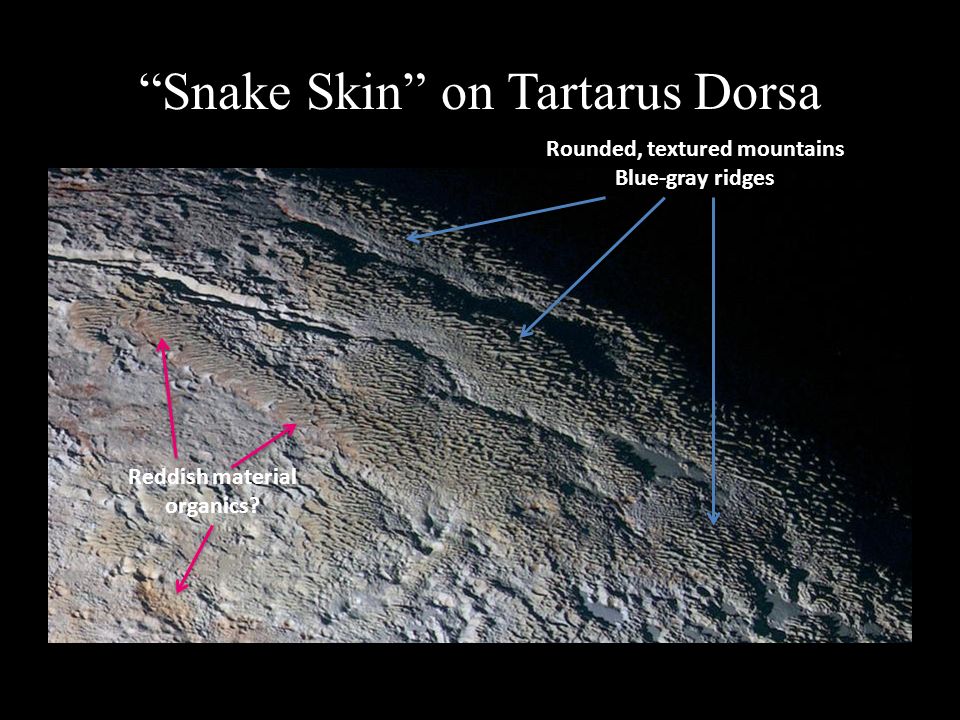
Fig. 1: Tartarus Dorsa, originally
described as a snake-skin structureNASA/JHU-APL/SwRI
First: The finding as such is not quite so new any more. The supposition that the region of Tartarus Dorsa on Pluto (fig. 1) might constitute an extraterrestrial equivalent of nieve penitentes has already been mentioned in our book Pluto & Charon, June, 2016. The news about it is the digital simulation by Moores et al. that has confirmed in December 2016 what had been but mere speculation in spring.

In the Alps or in the Pyrenees, you would not find any nieve penitentes because it is restricted to high mountains close to the equator, such as the Andes, Mount Kilimanjaro, the Elbruz or the Himalayas. The air must be very dry and very cold - maybe also very low-pressure? - to reduce layers of ice sublimating in sunlight to structures that grow most frequently up to 0.5 to 1.5 metres and to a few decimeters in width, though occasionally they may tower as high as six metres. They are arranged in regular spaces following the prevailing direction of irradiation. Mountaineers know this phenomenon also as ice spikes or ice blades. Despite its outward beauty, particularly when the moon is out, it is little popular because it is difficult to tread on and complicates making headway.

Fig. 2: Nazarenos as a model for snow penitents
By Pedro J Pacheco (Own work) [CC BY-SA 4.0],
via Wikimedia Commons
Ice blades have not been named by painter Rudolf Reschreiter, as you often may read these days, but by mountaineer Dr Paul Güssfeldt who first discovered them on Mount Aconcagua in 1883. In the Deutsche Rundschau journal, vol. 42, 1885, Güssfeldt recalled that he was first tempted to refer to the head-high ice spikes, 'which deserve to be introduced to science by a special term' as 'Kerzenfelder', candle fields,'until [mountain guide Lorenzo] Zamorano gave the better word nieve de los penitentes, or nieve penitente, "snow penitents", into my hand.' Lorenzo Zamorano was obviously reminded of the white pointed hoods of the nazarenos, the penitents of processions of the Spanish Catholic church (fig. 2). The term, nieve penitentes, was plainly claimed as the 'international name' of the phenomenon by the Popular Science journal in December 1917.

Concerning visuals, however, it was indeed Rudolf Reschreiter (* 1868; † 1939) who popularised snow penitents when he travelled the Cordilleras in 1903, in the wake of Prof Hans Meyer. On 12 July, Reschreiter discovered ice blades on the west slope of Mount Chimborazo, took photos (image 3) and converted them later into naturalistic paintings that Prof Meyer used to illustrate his 1907 book In den Hoch-Anden von Ecuador: Chimborazo, Cotopaxi, etc. One of these paintings is now on display in the Alpenvereinsmuseum Innsbruck.

Fig. 3 Ice blades rendered by
R. Reschreiter in 1907
Neither Güssfeldt nor Meyer were able to explain the origin of snow penitents beyond the obvious, namely that wind and sun had to be involved in some way or another. In 1917, Popular Science even smugly fell back on precipitated grains of 'meteor' dust to explain why ice blades should stay behind when a glacier was melting away. It was not before a hundred years later, in 2007, when a team led by M. D. Betterton finally managed to generate small-scale snow penitents in the lab:

'In nature, these spikes develop every year anew when tiny bumps on a surface of fresh snow scatter sunlight inside. More light causes more snow to evaporate, or sublimate - owing to the dryness of the air, the solid-state snow transforms into vapour. The process is accumulative: the depressions become deeper and deeper and, hence, can "trap" more and more sunlight, so that at the end there are deep troughs between which those ice spikes have remained. In winter, when the sun is less powerful, fresh snowfall fills in the troughs, so that in spring, another level surface will welcome the sun. The spikes protect the glacier surface in two ways: On the one hand, they cast shadows so that less surface is exposed to the sun. On the other hand, their three-dimensional structure multiplies the available surface of the glacier - providing more surface for heat exchange, and cold mountain winds can cool the ice more effectively.

To accelerate the process, Betterton's team had spread toner particles from a photocopier on fresh blocks of snow. If the particles were spread thin enough to let light pass to the ice, troughs developed there as well. The toner particles then protected the ice spikes against irradiation and you had to wait only half an hour, rather than three hours, for "ice blade forests" to develop.
' (Was this approach inspired by the 'meteor' dust hypothesis?)
(Translated from Welt der Physik)

This model had a drawback, though: it still failed to explain why the ice blades would be set in regular spaces and turned parallel to each other. A study published by Philippe Claudin in 2015 helped explain this:

'Regarding the characteristic spacing of these troughs, Claudin and his colleagues found that vapour diffusion at the surface is essential. It" see only when there ares significant local variations in the vapour contents of the air precisely above the surface that one part of the surface can sublimate quicker than another. But lateral diffusion [by wind] suppresses look thus if this diffusion is almost, discrete penitentes can only grow a long distance striking. In other Word, the separation of the penitentes increases with the diffusion advises.'

However, the structures in Tartarus Dorsa on Pluto are very different from those on Earth. Firstly, they are arranged not in one but in three different directions, interpreted by Moores et al. as a sign of high age, while ice blades on Earth do not survives even a full year: Pluto must have changed its orbital parameters several times while they were growing. Secondly, they are overwhelmingly gigantic: Made of frozen methane rather than water ice, they are not restricted to Reschreiter's hip-high spikes but grow to pillars that loom up to 500 metres and stand so far apart that you could squeeze a colony in between!

A viewer on the surface of Pluto must consider Tartarus Dorsa a wonder of nature that only the most daring SF authors might have imagined. Maybe this description comes closest that Stanislaw Lem gave of the fictive Wood of Birnam on Saturn's moon Titan in his novel Fiasco (1985): 'The furious play of chemical radicals … created a crusty porcelain jungle that atteined heights of a quarter of a mile; the weak gravitation assisted its growth, so that there were treelike formations and thickets of glassy white laid upon each other in successive layers. … The enormous bulk was actually a solidified cloud formed of spiderweb capillaries in every shade of white, from pearly opalescent to dazzling milky.' It would be worth knowing whether snow penitents may also occur under the conditions prevailing on Titan - may this explain the remarkably bright features of the landscape of Xanadu?

Now here is a challenge for you artist illustrators: What would the ice spike forests of Tartarus Dorsa look like for astronauts landed on the ground?

Codex Regius, in January 2017